


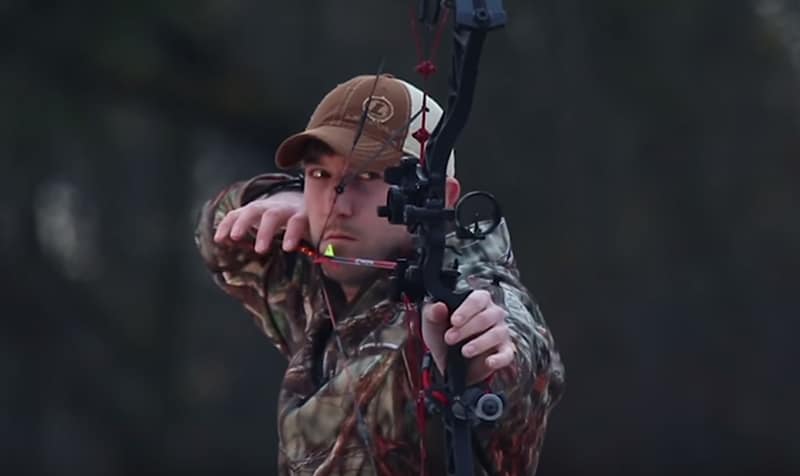
Will your point of impact change if you use NOCK OUT lighted nocks from Clean-Shot Archery vs. regular nocks? HuntStand Editor Josh Dahlke, a self-admitted “average” bowhunter, seeks to answer that question in this video.
A cold front is rolling in as Tyler Ridenour goes into the third day of his much-anticipated Iowa bowhunt. An Iowa buck shows up and quickly gets interested in Ridenour’s buck and doe decoy setup.
Darren Hasson from Elite Archery is bowhunting the eastern Canadian moose in New Brunswick, Canada. See what happens when a big bull gets called into range.
Elite Archery has coined the term “shootability” with their extensive line of compound bows, but what exactly is shootability? HuntStand’s Josh Dahlke and Tony Peterson discuss this term and how it applies in the real world of bowhunting.
Federal Premium Ammunition’s 3rd Degree turkey load was engineered to provide wide patterns at close range, while also offering turkey-killing power out to 50 yards. In this video, HuntStand Editor Josh Dahlke tests and reviews 3rd Degree to see if it performs as promised.
ALPS OutdoorZ is introducing several new, high-performance hunting packs for 2015 in the “Extreme” line. Here’s a closer look with details about these Extreme packs.
The Osceola subspecies is a treasured trophy for hardcore turkey hunters. In this “Shot of the Week,” Brian Stephens heads to central Florida to see if he can kill an Osceola gobbler with his bow.
Brian Stephens brings us along for an intense spring turkey hunt in eastern Tennessee. Without the concealment of a ground blind, is Brian able to draw his bow on a bird and make the shot?
Tiffany Lakosky from The Crush travels to central Kansas and kills a giant Kansas whitetail buck with her bow.
Fall-season bass fishing might change from year to year, in the fact that some years you can be fishing your favorite lake or river in shorts and a T-shirt in November, while other years you might be breaking a thin layer of ice to get your boat out on the water. Regardless of the year, there is one form of cover that holds bass this time of year and that is laydowns.

As leaves begin to change colors, the bodies of water we fish change as well. The majority of vegetation we had to fish all summer will be dead and boat docks are pulled for the winter. Bass will move to the last remaining cover that’s available, which is usually laydowns.
Some lakes or rivers have more laydowns than others, but they will all hold bass … and oftentimes more than one. Finding the key laydowns is vital, as many times the best laydowns will have a school of bass on them, feeding heavily for the long winter ahead.
Productive laydowns are commonly located near deeper water, as the pockets of deep water might be the bass’ wintering hole, or just an area they can move to should a major fall cold front push through. I like to take a look at my LakeMaster mapping chip to identify possible areas where deeper water butts up to shore, and then idle those areas confirming the water depth with my Humminbird and scoping out the shoreline for wood.
On a river system such as the Mississippi, a key laydown will often be situated between current and backwater lakes, where bass are transitioning to the backwaters for winter. Many times a good series of laydowns will aid in slowing down the current, giving bass a perfect ambush spot to grab a quick meal.
HOW TO FISH LAYDOWNS
When I find a good laydown, I want to work that piece of cover as thoroughly as possible, so I’ll slowly approach the target using my trolling motor and then deploy my Minn Kota Talons. This will keep me from blowing into or away from the cover, and it allows me to focus on covering every inch of that laydown.
Your first few casts should target the outer edges of the wood, as you don’t want to disturb the inner most area of the laydown initially. To work the outer edges, I will start with reaction lures to grab any active bass. A single Colorado-bladed spinnerbait and square-billed crankbait get the nod here, because they allow me to cover water quickly.
 As the temperature drops, bass will move to laydowns for a sense of stability.
Because I’m fishing shallow water and want some stretch in my line, I’ll spool up my Wright & McGill Victory Pro Carbon reel with 15-pound Seaguar Senshi mono; this will keep my square-billed crankbait from getting hung up and help keep a bass hooked as it surges to deeper water when it’s hooked.
Once I pick off the active fish with these lures, I’ll slow down and pitch of a jig or Texas-rigged soft plastic around the perimeter of the laydown. Being that the cover on the edge isn’t as thick as the middle of the laydown, I’ll use a 1/4-, 5/16- or 3/8-ounce weight, depending on the wind and water depth. As I begin to flip deeper and deeper into the cover, I’ll up my weight so I’m sure the bait gets below the surface and into all the nooks of the tree. Many times, a 3/8- or 1/2-ounce weight is what I’ll use.
One area you want to make sure you work several times is right where the laydown meets the shore, as many times there might be a deeper hole here, rock on the shoreline, or some dead vegetation that has blown in.
TACKLE FOR FISHING LAYDOWNS
A heavy-action flipping rod and tough line is needed when flipping into heavy cover, to hook those bass and then get them into the boat. I rely on a Wright & McGill 7-foot, 4-inch Victory Pro Carbon rod and 20-pound Seaguar TATSU Fluorocarbon line when the water is clearer on lakes, or 65-pound Seaguar Smackdown braided line when I’m fishing the stained river.
 The author’s go-to laydown jig fishing setup: a Wright & McGill Victory Pro Carbon rod and reel, Seaguar Fluorocarbon line, and a War Eagle Jig and Zoom Trailer.
I’ll Texas-rig a variety of soft plastics on a 4/0 TroKar TK130 Flippin’ hook, such as Zoom Z-Hogs or Super Hogs, when the water is clearer. Super Speed Craws get tied on when the water is stained. For a jig, I like a 1/2-ounce War Eagle Flipping jig with a Zoom Super Chunk as a trailer.
 A trolling motor and shallow-water anchors are extremely helpful tools for effectively fishing laydowns.
Keeping your color section simple is important in not weighing your boat down with excessive plastics, so having a handful of different natural green pumpkin baits with varying flakes in them and the standard black/blue is all you’ll need.
With the fishing season for bass getting shorter and shorter each and every day this fall, be ready to hit your favorite body of water to target some late-season bass on laydowns!