



Now that spring turkey season is behind us, it’s time to come to terms with our failures and plan for future success. Don’t miss your next turkey dinner because of a bad shot. Here are 10 of the most common reasons you might miss a shot on ol’ tom.
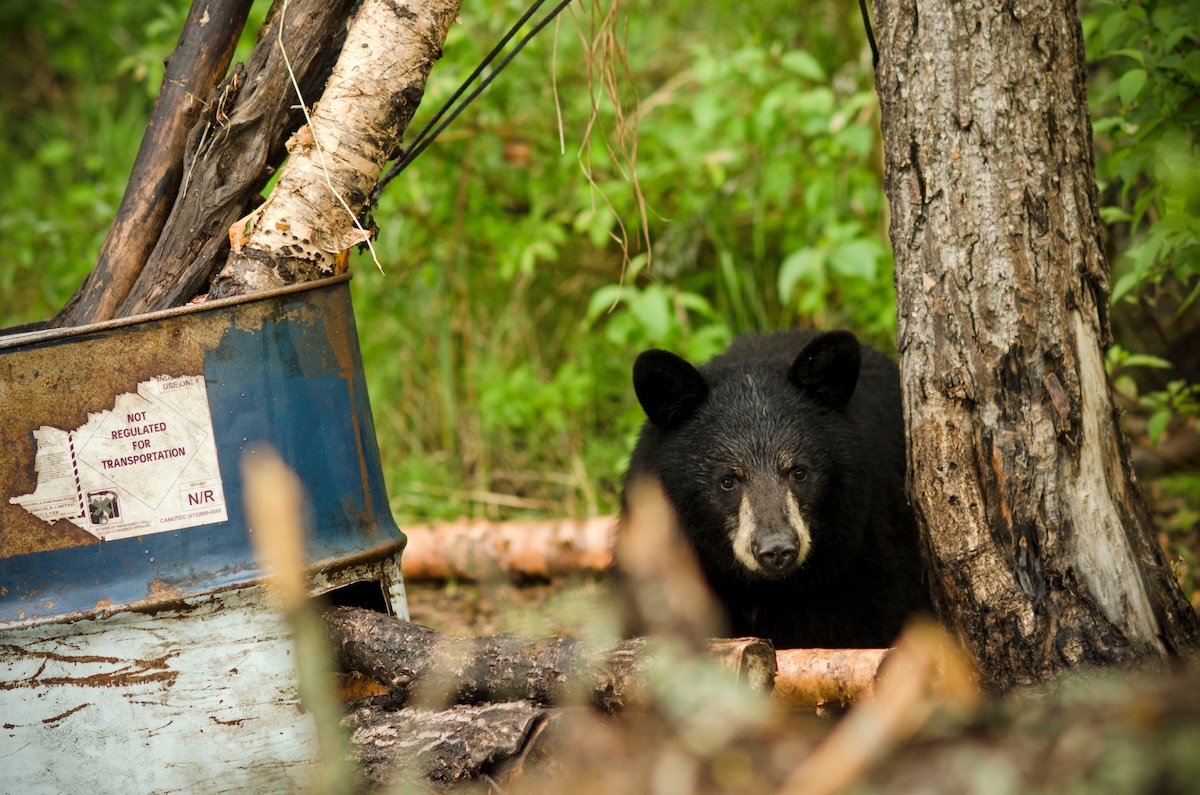
For five days we didn’t rise to the sound of an alarm clock, and most of us were too tired to be awakened by the nagging rays of dawn. Instead, each morning was loudly announced by a chorus of hunt-ready hounds. These eager canines craved the scent of fresh bear sign and the hot pursuit that’s likely to follow. So did their human companions.
Our six-man crew of hunters joined the black bear hunting experts of Table Mountain Outfitters (TMO), owned by Scott and Angie Denny. Their team of houndsmen and guides have decades of combined experience running bears with dogs. I spent my first morning with Adam, respected as “the man” when it comes to this complicated style of hunting. Adam quickly, methodically drove the Forest Service roads with his pack of hounds at the ready—one dog strapped to the hood of the truck, and several others kenneled in the back.
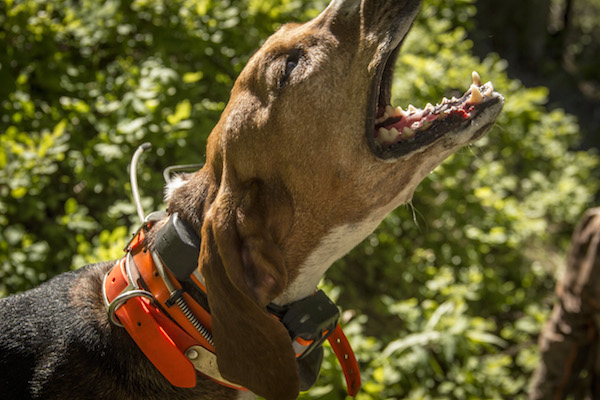
Within a couple of hours, all hell broke loose as the dogs started uncontrollably barking. They had caught wind of a fresh track. Adam hit the brakes, jumped out of the truck and collared each dog with a Garmin GPS transmitter, which sends a signal to handheld receivers. It’s an uncertain affair—you never know if the dogs will lose the trail or catch up to the bear—but in this case, the GPS confirmed the dogs were on the heels of the bear.
“Running bears is kind of like controlled chaos on a massive scale,” Adam explained. “They’re running across mountains and through crick drainages. If we stopped them right now, they’d be pissed. They’re happy right now. This is what they want to do.”
How to Spot and Stalk Spring Black Bears

After a 10-mile race, the dogs stopped moving on the monitor of the Garmin receiver and the LCD screen read “TREED.” Adam strapped on his cleated boots and told us to sit tight, as he would hike the 1.5 miles to the bear and radio us if it was a bear worthy of taking. We—the shooters—were anxious to join him, so the idea of staying behind was tough to stomach. But Adam knew we had five days ahead of us, and the wise choice would be to save our energy and acclimate to the elevation before taking on the steep, oxygen-deprived slopes that we were unaccustomed to. Less than an hour later, we learned the bear was too small. Contrary to Adam’s wisdom, we decided to trek into the treed bear for a closer look. After an exhausting hike, we reached the riled-up dogs as they barked in victory. The bear—albeit young—was a marvelous sight.
Southern Idaho is wrapped in stunning, diverse landscapes. From Boise National Forest to the rugged Sawtooth Mountains, there’s no shortage of adventures to be found in this spectacular region of the potato state. If you’re ever in the area, find time to venture into the charming town of Stanley and make a stop for breakfast at the Elk Café. After you get your fill of local flavor and friendly conversation, head to one of the many public trailheads for a hike into the Sawtooths. Unless you’re fully prepared and feeling dangerous, stick to the trail—we learned that the hard way.

We only employed the hounds from early morning until lunchtime each day. “There’s no stopping them,” Adam noted. “They’re like heat-seeking missiles.” As the TMO crew knows all too well, there’s always a risk of getting into a race that might last well into the dark of night. So, while the dogs took the afternoons and evenings off, we sat on bait.
My first evening on the bait revealed no bears. The mosquitoes viciously swarmed and I couldn’t stop swatting them away. My cover was blown. I dug in my pack to retrieve my Thermacell, but I had left it back in camp. I wouldn’t make that mistake again.
5 Best Spring Black Bear Hunts (in Canada)
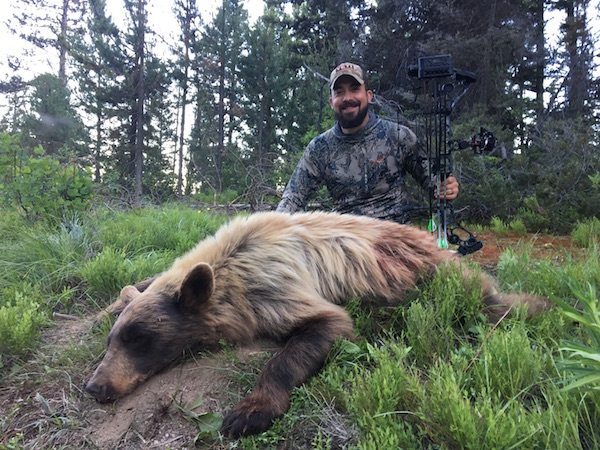
At a nearby bait site, Ben O’Brien’s luck was different. Ben is the hunting marketing manager for YETI Coolers, so his day job of slinging high-performance cooling gear is often connected to his favorite pastime of filling a YETI with wild meat. He scored a stunning blonde color-phase black bear with a bow shortly after settling into his stand. With a perfectly executed double-lung shot, the tremendous beast went only 30 yards before quickly expiring. Just the way it ought to be.
Dogs at the ready, our caravan of pickup trucks cut across the gravel roads at dawn the next morning. Not long into our drive, the hounds fired up to alert us of bear in the air. Scott and Angie cut ’em loose and another race was on. This one ended quickly with a treed bear. We traversed a steep drainage to reach the howling hounds and set our sights on their prize. A medium-sized black bear with a cinnamon coat glared at us from above, skillfully balancing on the sturdy limb of a mature pine tree.
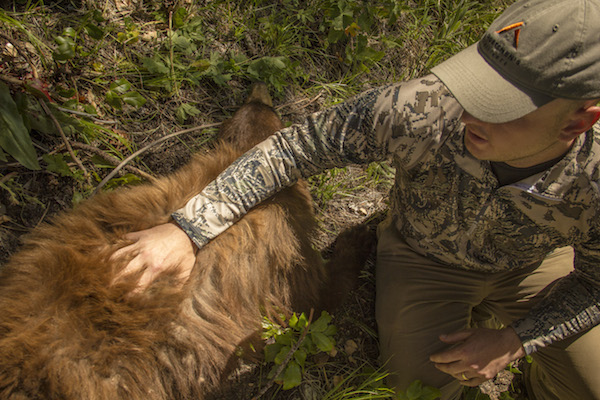
Everyone in our crew had been blessed with bear success during past hunts, but for Evan Heusinkveld, president and CEO of Sportsmen’s Alliance, this great bear would be his first. There are many benefits of hunting bears with hounds—most notably, it gives hunters ample time to analyze a bear up close and determine if it’s the “right” bear to kill. Unless it’s an off-limits bear (in the case of Idaho, a sow with cubs), there is no right or wrong—as the trophy is in the eye of the beholder. Evan evaluated the gorgeous animal, chose the best position for a clean shot, and soon we joined him in celebrating his reward.
The hunting of black bears with hounds and bait is continually being attacked by anti-hunting organizations such as the Human Society of the United States (HSUS). At face value, it can be easy to convince the non-hunting public that these two means of bear hunting are barbaric, unfair or “too easy.” Four years ago, prior to my first baited black bear hunt, even I had mixed feelings about sitting over an artificial food source. Then I tried it—on two different trips, in two areas with extremely high bear densities—with no success. Easy? Not so much. But this type of issue can’t be settled based on emotion, opinion, personal preference or even tradition … it’s a matter of scientific wildlife management.
Spring Bear Hunting: How to Hunt Trophy-Class Black Bears
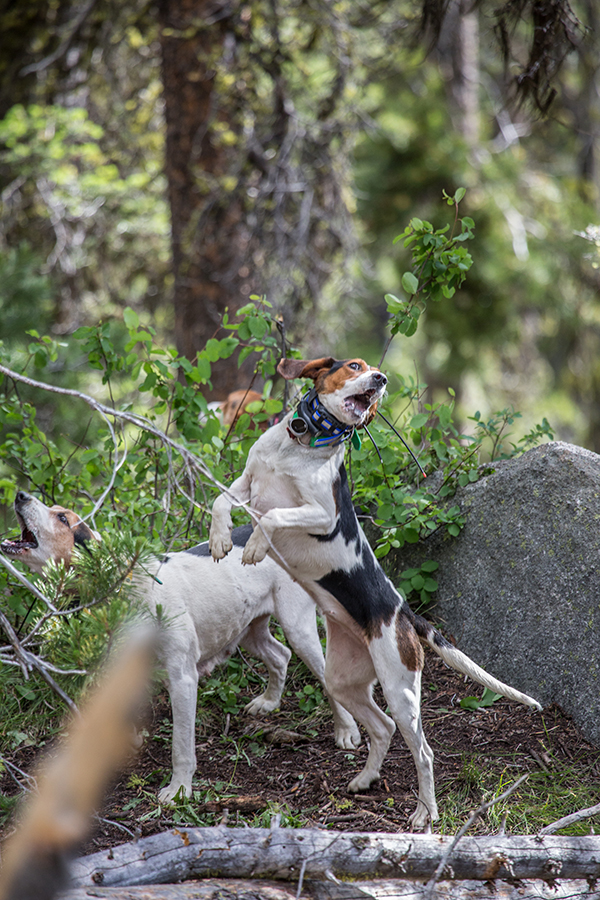
Baiting and hounding are the two most popular means of hunting black bears because they’re the two most effective ways of managing the species. Don’t take my word for it—just venture into the habitat of black bears and you’ll face the immediate realization that spotting and stalking, or scouting and sitting, are next to impossible. According to the National Park Service, “It is estimated that black bears’ sense of smell is about seven times greater than a bloodhound’s.” Without the ability to chase bears with hounds or attract them to a controlled food source, hunting the cunning predators is nearly futile. Sure, some spot-and-stalk opportunities exist in their Western range and along coastal Alaska, but responsible management through hunting would be virtually impossible without the aid of bait and hounds.
“Similar to the attacks on trappers, dog men have seen their fair share of attacks in recent years,” Evan explained. “Anti-hunting organizations have gone after bear hunting with dogs in California and Maine. They’ve tried to stop wolf hunting with dogs in Wisconsin.” In 2012, the California legislature imposed a total ban on bear and bobcat hunting with hounds. As a result, bear harvests have dropped 50 percent and human/bear conflicts have rose dramatically in urban areas. Colorado, Oregon, Washington and Massachusetts have also banned bear hunting with hounds, each case resulting in serious bear management issues. “We need you to help us [Sportsmen’s Alliance] expand our ranks so that we can engage in more battles, and win more fights that will protect houndsmen, trappers and every other type of hunter into the future,” Evan noted. You do that by clicking here to show your support of Sportsmen’s Alliance in a number of ways.

Despite a recently blown-out Achilles tendon, Brian Lynn, vice president of marketing and communications at Sportsmen’s Alliance, cautiously trekked into a frenzy of TMO hounds after an exciting race. It was the final day of our hunt, and Brian finally got his chance to claim a bear of his own. He arrived at the tree and carefully considered if this was the bear that he’d put his tag on. His answer came quickly and soon he admired a cinnamon beauty.
Patience paid off, and my encounter with a remarkable black bear came while sitting in a ground blind just 15 yards from a bait barrel. Eerily, we watched the bear approach from the same trail we had walked in on just minutes earlier. At first sight, it was obvious that this was a bear I’d gladly take. I steadied my rifle (and my throbbing heart) and punched a bullet through the bear’s boiler room. He went only 40 yards before tipping over.
Hunting Pressured Fall Black Bears
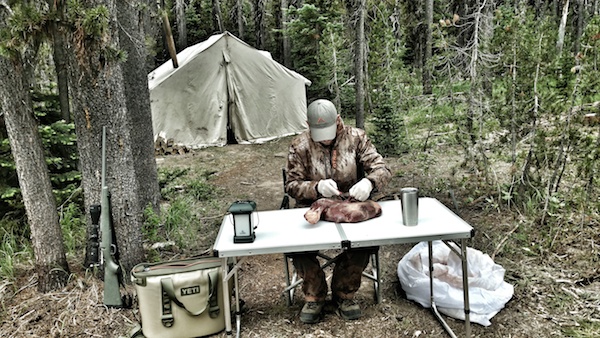
What do you do with a bear after you kill it? I’ve been asked that question a number of times. The bear is skinned and its hide is turned into taxidermy—a way to honor the animal and cherish the memories from the hunt forever. And despite ignorant stigma, bear meat is fine table fare when properly cared for. Cool it quickly, go to work with a razor-sharp blade, and transform each fine cut into food. Remember to share with friends, family and other folks who need a tasteful reminder of why we hunt.
Pay attention when you drive by any milking operation and you’ll almost always see circling flocks of pigeons. Contrary to popular opinion, I actually think pigeons are beautiful birds. Trouble is, they’re … well … crappy. They’ll soil every imaginable surface of a farm, and if left unchecked their plague can become downright disgusting and unsanitary. Luckily, for those of us who have a knack for busting birds out of the sky, pigeons decoy exceptionally well and make for quite a wild afternoon of wing-shooting. Here’s how to go about hunting pigeons on farms.
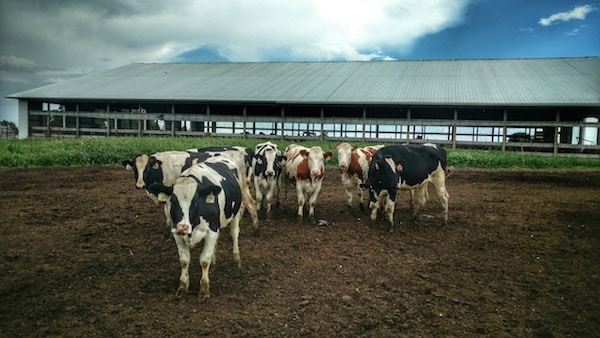

Pigeons commonly hang out around cattle operations.
Decoying Pigeons
Todd Gifford (aka “CrowMan”) owns a business that specializes in pest control—most notably pests of the avian variety. Gifford is known mainly for his astonishing record of more than 15,000 logged crow kills, but he’s also a professional pigeon slayer.
Gifford uses pigeon decoys. These lifelike, full-body plastic impostors are foolproof for sucking birds into range for waiting gunners. Everyone should keep a set on hand for those times when we’re eager to get outside and knock the dust off our scatterguns.
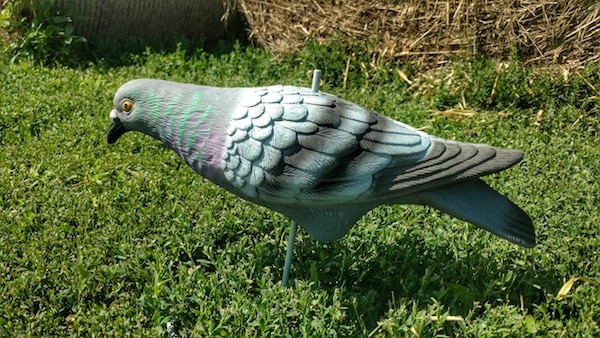
Use decoys to boost confidence in circling pigeons.
Hunting Pigeons
We arrived at the farm in the mid afternoon. No need to get up early or stay late for pigeons — they’ll fly, decoy, and die all day. The key is finding a cattleman who has a pigeon problem, and then it’s a matter of building a relationship to gain access to the farm and become the well-armed solution to his problem. There’s a lot of trust and responsibility in this arrangement, as the best shooting will take place in the core of the farmyard amongst buildings, equipment and animals. Safe shooting lanes, careful shots and situational awareness need to be top of mind at all times. Get your game dialed in and you can expect consistent action.
Earlier in the day, our crew assembled at a backyard shooting range and warmed up our shoulders over a Champion WheelyBird. Busting clay pigeons then banging the real thing — there’s no better way to exercise your shotgunning instincts and prepare for a serious fall season of hunting game birds.
Our crew wasn’t even in position when the birds started circling the decoys and setting their wings. Within minutes, the first birds hit the dirt. Pigeons can turn on a dime and outmaneuver some of your best shooting, so you quickly learn to respect the challenge of these aerial adversaries.
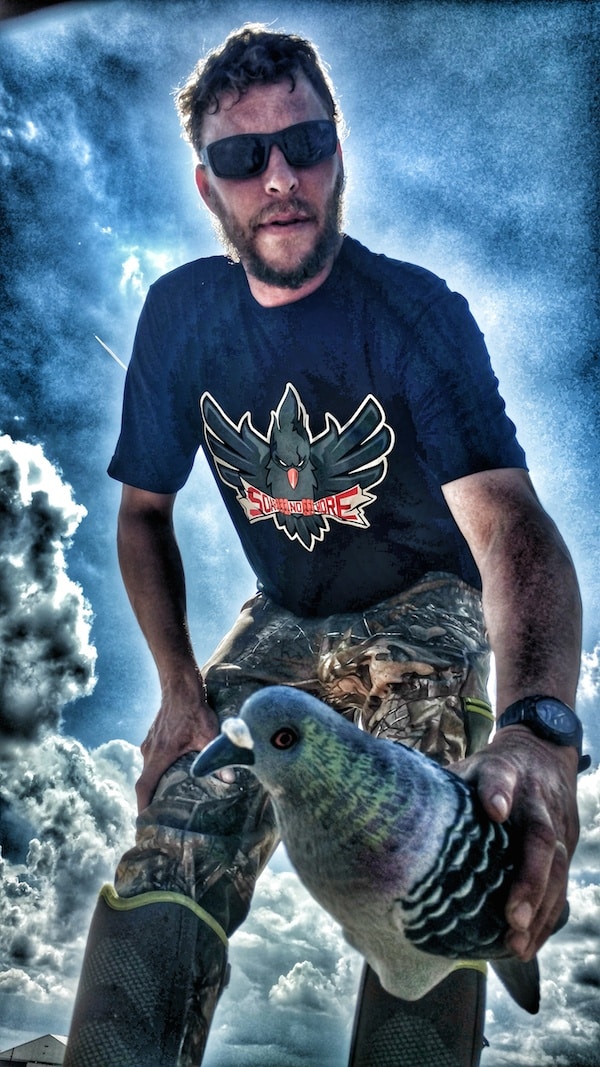
Set up shot around cattle barns, milking areas, feed lots, and more.
Tools of the Trade
We were shooting Federal Premium high-brass upland loads through autoloading shotguns. Shots ranged from in-your-face 10-yarders to a couple of 50-yard pokes with long leads over the roof of the cattle barn.
For a stir-crazy sportsman, hunting pigeons is an excellent option when our summer “down time” is getting us down. With a cooler full of cold beverages, polarized sunglasses and a Thermacell to keep the bugs away, a session of dropping pigeons is better than a day at the beach.
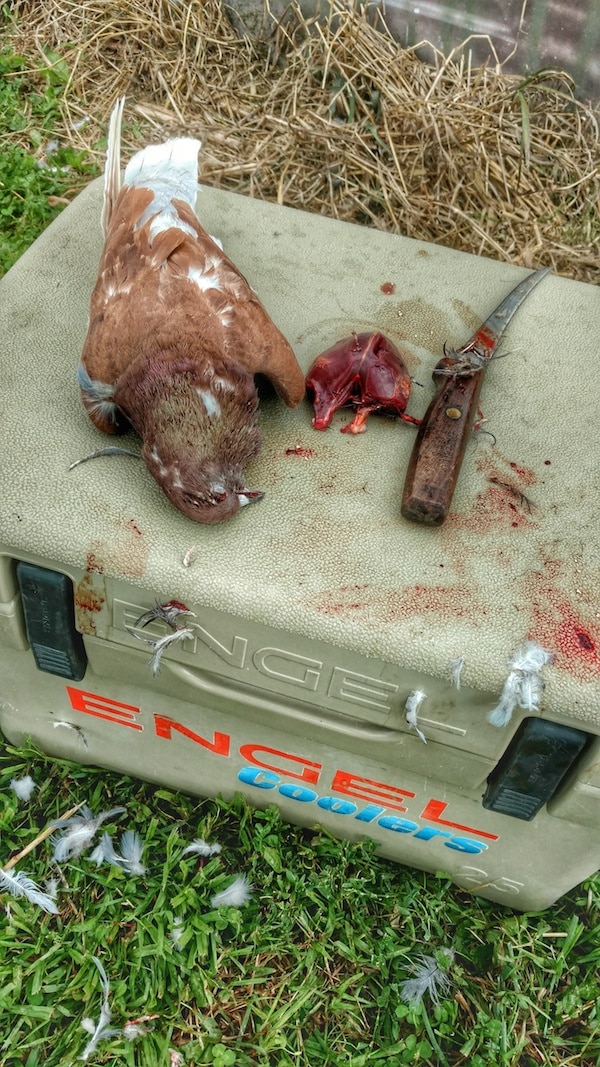
Don't overlook pigeon meat.
Cooking Pigeon Meat
Eating pigeons? It’s not out of the question. The red breast meat of a pigeon is much like that of a dove, which most educated carnivores would call a delicacy. Check out my post at OutdoorLife.com, where my cohort Krissie Mason will soon be firing up a recipe with a few of the pigeons that starred in this photo essay.
We knocked about 60 birds out of the flock during our 2-hour shoot. Not too shabby. It was the first time I’d set my sights on these avian acrobats, but it certainly won’t be my last.
The Maestro | Paul Butski’s Legendary Voice | HuntStand Original
The folks at Work Sharp make a stellar line of products for keeping your knives and tools sharp. When it comes to keeping an edge on your hunting knives, consider the economical and extremely efficient Guided Sharpening System. This handy sharpener works well on a variety of blade types—curved or straight. #theHUNGER
“My fear of losing hunting goes far beyond selfish desires. It’s not about losing the ability to hunt as an activity, to kill for reward, or even put meat in the freezer. It’s about losing an entire community who understands the vulnerabilities of our natural resources better than anyone else.” #theHUNGER
Do your part to save hunting and wildlife:
SUPPORT SPORTSMEN’S ALLIANCE
Looking for a lead-free hunting ammunition? Nosler’s E-Tip is a fantastically built lead-free bullet that’s loaded in several calibers of Nosler ammo. The E-Tip is ideal for deer, black bears, pronghorn, elk and most big-game animals.
Like it or not, “traditional” ammo is being phased out by legislation in some popular hunting destinations, so finding a lead-free (nontoxic) alternative might be something you need to consider depending on where your travels take you. For example, lead-free ammunition will be banned statewide in California starting July 1, 2019.
Preparing wild meat for the table doesn’t have to be tough—neither in the task of cooking nor the texture of your finished product. One of the easiest ways to cook venison, game birds, fish or anything else of the all-nat-ur-al variety is smoking. You heard right. No longer do you need to reserve an entire day for standing over a smoker and watching the temperature like a hawk. Smoking meat is easy if you have the right tools for the job.
I’ve been using the SmokePro pellet grill and smoker from Camp Chef for nearly 2 years. Watch this video and you’ll begin to understand why my smoking addiction continues to grow. #theHUNGER
Mossberg’s Patriot Revere is dressed like a gentleman, yet modestly priced to keep it within a working man’s budget. See how it performed during a plains game hunt in South Africa.
[SEE THE FILM]
Hunting For Meat In Africa
We’ve been testing the new 2018 Yamaha Wolverine X4 SE side-by-side vehicle, at home and on the road. At first glance, you might think the Wolverine was built strictly for trail riding, but digging deeper you’ll realize it’s also made to do work. Here’s a look at our first impressions after using the machine for a week in the Badlands of South Dakota. #theHUNGER
“Until you’re squared off with Alaska and she’s spitting square in your face, you don’t know what it means to be tested out here. Every gust of wind, grain of sand, and drop of rain will beat you down, and in every passing moment you face the choice of tapping out or getting back up.” Join us in Southeast Alaska, where we hunt coastal brown bears under the guidance of Charles Allen and share his story of modern pioneering. #theHUNGER