


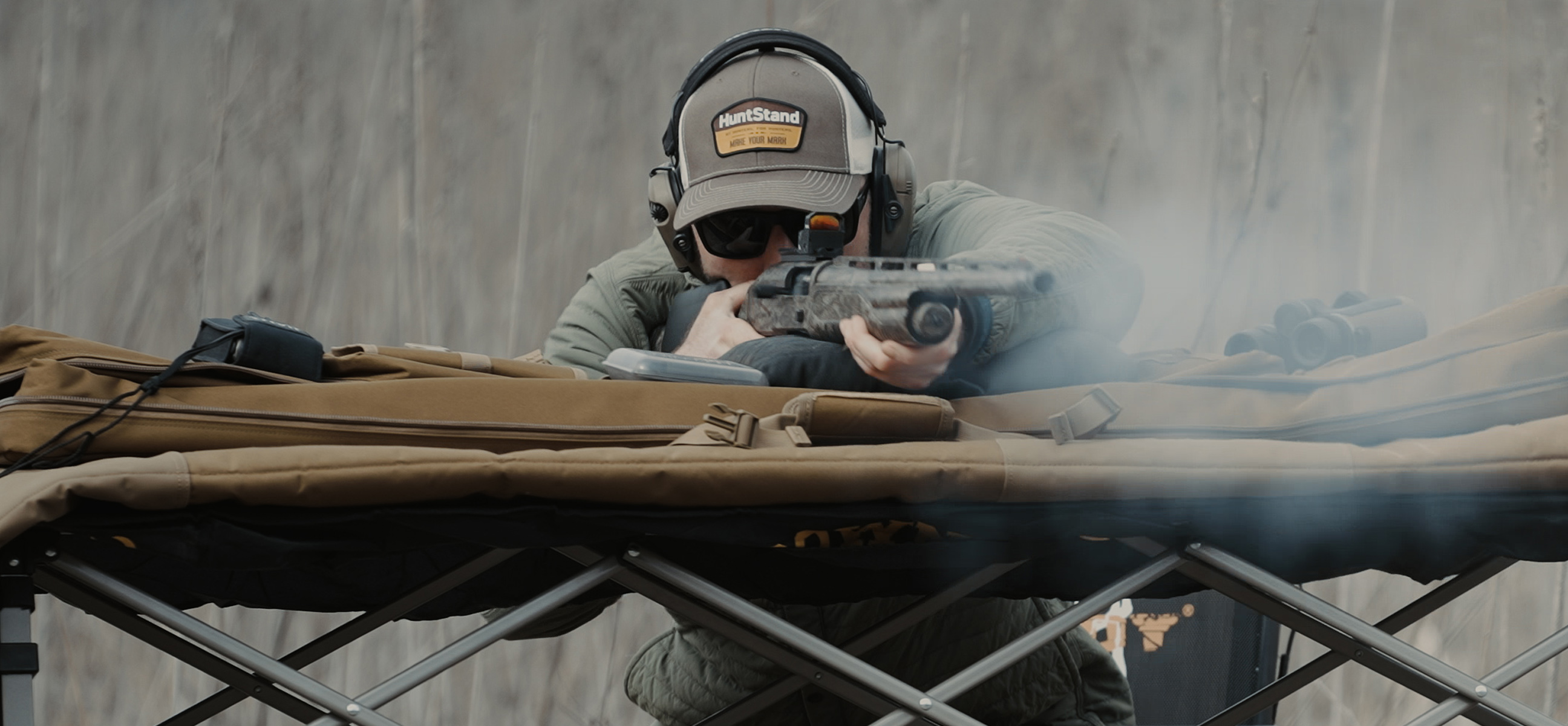
You’ve got your turkey vest loaded up, you’ve done all your scouting, and you’re ready for your next turkey hunt. But have you overlooked one of the most important steps toward a successful turkey hunt? You need to pattern your shotgun for turkey hunting. Watch the first part of this video above to learn the basics of turkey gun patterning, and stick around until the end if you want to take your turkey gun to the next level. Or you can read on below for the full scoop on patterning your shotgun for turkey hunting.
The Basics of Turkey Gun Patterning
What does it mean to pattern your turkey gun? It’s the process of target shooting your shotgun with the shotshell that you’re going to use for turkey hunting. It’s critical to do this and see how your pellet pattern will look downrange. No different than sighting in a rifle for deer hunting, you need to know where your projectile is going to hit when you squeeze that trigger — or in this case, what your distribution of pellets looks like as they’re heading for a turkey.
Patterning a shotgun for turkey hunting is easy. All you have to do is shoot some paper. Or cardboard. Or a turkey target. Whatever you’ve got to shoot safely that will show where the pellets are hitting.
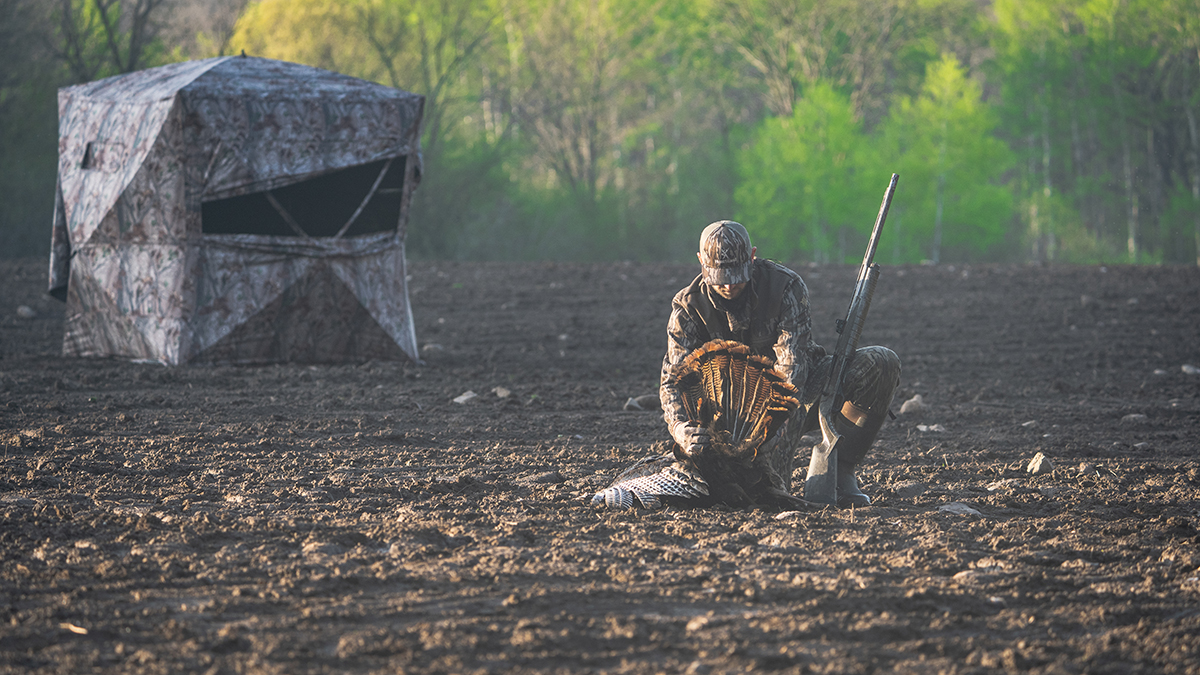

Patterning your turkey gun will result in more sacred moments like this.
At minimum, choose one turkey load off the shelf. There are tons of turkey loads to choose from, but select a load that’s labeled for turkey hunting and pattern it at 40 yards. Forty yards was established as the standard turkey shooting distance a long time ago, and it’s still considered the standard today because any turkey load worth its salt should provide a good enough pattern and lethal energy at 40 yards to kill a turkey. You should also be shooting a full or extra full choke tube if you want to hold a tight pattern out to that magic 40-yard mark. You can probably get away with a modified or improved cylinder choke if you’re shooting Federal Heavyweight TSS; it uses a special Flitecontrol Flex wad to hold tighter patterns with a less-constricted choke.
The reason you need to pattern your chosen turkey load is because you need to understand what that pattern looks like, and how it’s shooting out of your gun. Just about every turkey load will shoot differently out of any given shotgun, so before you start cracking away at gobblers, it’s your responsibility to know what that pattern looks like.
App Layers and Tools for Backcountry Turkey Hunting

You need to understand what your pellet pattern looks like at all possible shot distances.
If you’re using fixed sights, you might just have to compensate your aim if the point of impact isn’t true to your aim. But that’s why you should thoroughly consider an adjustable sight system on your turkey gun, whether it’s a simple adjustable fiber-optic sight system, or even better — an optic like a red dot. This will allow you to sight in your turkey gun just like your deer rifle. Shooting turkeys isn’t like shooting other upland birds. You shouldn’t be shooting instinctively. You should have a shot process, just like you do with a rifle. Even the most basic turkey gun should be treated like a precision shooting tool — don’t spray and pray — you need to aim, squeeze, follow through … and be ready to make a follow-up shot if you screw up the first one.
Advanced Turkey Gun Patterning
You’ve got your shotgun, you’ve chosen a full or extra full choke tube, you’ve picked a decent turkey load, and you know where your pattern is hitting downrange. You’re ready to hunt. But if you want to get serious about maximizing the potential of your turkey gun and up your odds of killing gobblers more effectively, stick with me.
Like I said before, just about any old shotgun can be used as a “turkey gun.” But these days, for those of us who geek out on all things turkey hunting, we’re blessed to have some badass shotguns that are purpose-built for turkey hunting.
Biggest Threats to the Wild Turkey
The DNA of a Turkey Gun
So, what makes a shotgun a true turkey gun? Well, just like anything in hunting, that’s a conversation that can get people pretty riled up. But I’ll try to keep it practical. A good turkey gun should probably be camouflaged, it needs to function reliably with no hiccups — because when you finally get a chance to kill a bird your gun can NOT be the weak link.
A lot of turkey guns have pistol grips or thumbhole stocks, which can be nice. And a sling — you definitely want a sling to be hands-free as you’re running and gunning. And perhaps most importantly, a turkey gun should have an adjustable sight system. You need to be able to adjust your sights to match your pattern, so your point of aim is true to your point of impact. And going a step up from that, please consider a red-dot sight. Let me explain why …
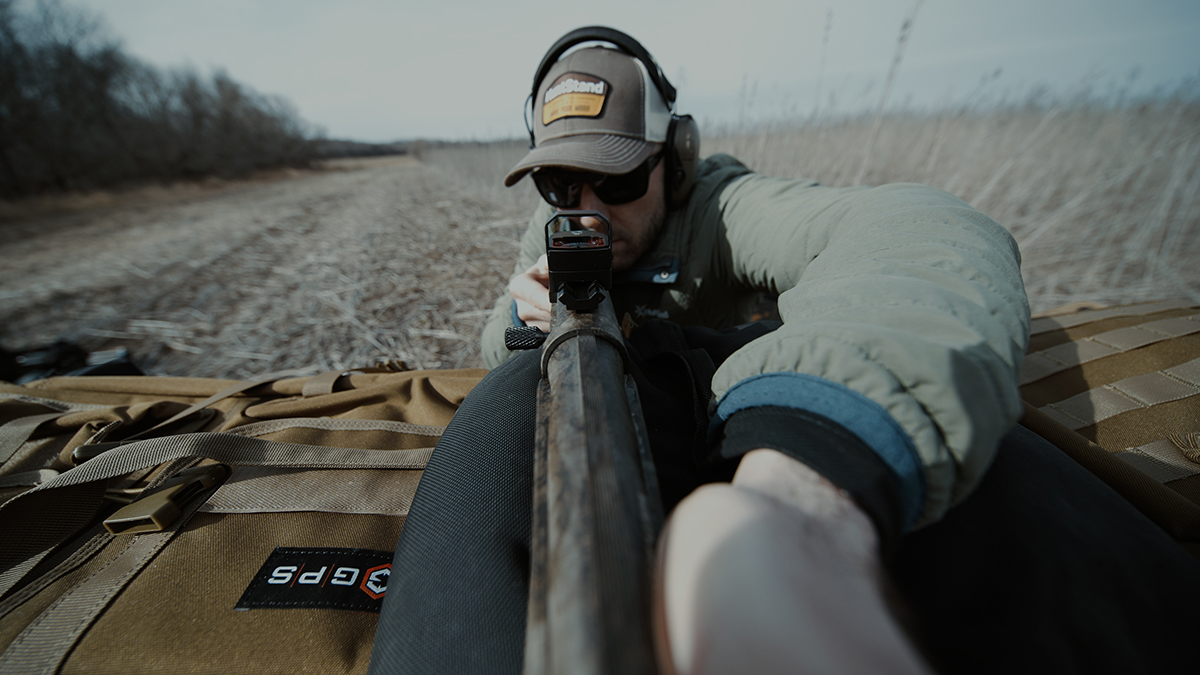
Choosing an adjustable sight like a red dot will allow you to sight-in your turkey gun for precision shooting.
Red-Dot Sights for Turkey Guns
A red dot gives you the adjustability you need to sight in your turkey gun. But more than that, it gives you a precise aiming point to be able to shoot gobblers perfectly at close range or farther distances. A plain bead sight or even a fiber-optic sight begins to cover too much of the bird at distance — even at 40 yards — and it can be just as easy to miss a bird at close range with a basic sight system. Red dots also excel in all light conditions because they have adjustable illumination levels.
Another huge benefit of a red-dot sights is that they’re parallax free – so even if you’re not perfectly mounted on your gun, your shot is going to hit exactly where you see that dot on the target. Finally, one of the biggest reasons people miss turkeys is because they pull their head off the gun as they’re pressing that trigger when they’re looking down a barrel through a more traditional sight system; a red dot does a good job of forcing you to keep your head down and follow through with the shot, because you know if you don’t see that dot, you’re not aiming.
Whether you go with a red dot or not, just make sure you have an adjustable sight system.
Best Ways to Improve Your Land for Wild Turkeys
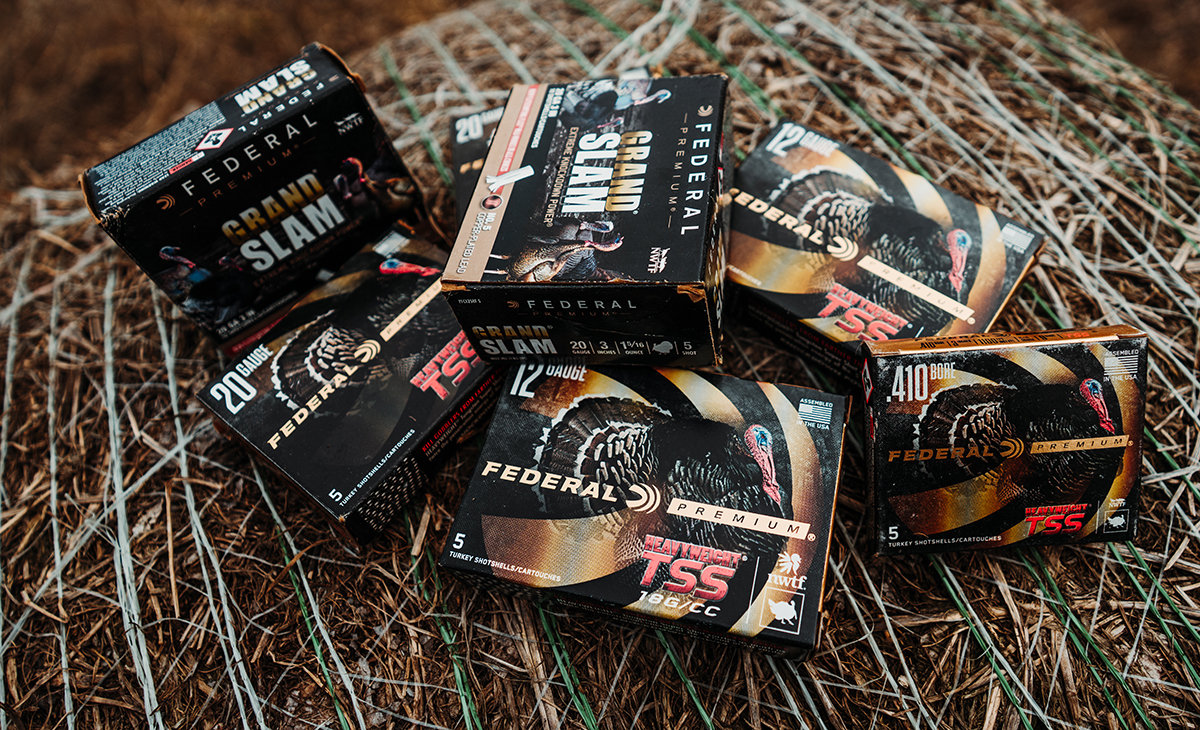
Test multiple turkey loads of different variations in velocity, pellet size, pellet type, and payload weights, to find the best combination for your style of hunting.
Turkey Ammo & TSS Talk
Now, let’s talk briefly about turkey load selection. Turkey shotshells have come a long way in the past 20 years. The old reliable copper- or nickle-plated lead shot in a standard wad has been killing turkeys for decades, and it will continue to do so. But one of the best ways you can get better performance out of your turkey gun is by investing in Tungsten Super Shot (TSS). TSS is expensive, because the tungsten alloy material is expensive, but it’s way denser than lead — like upwards of 60 percent denser than lead.
What this gets you for your turkey load is the ability to use a smaller shot size while still retaining lethal energy. With smaller shot size, you can pack more pellets into your payload, and so what you’ll see on paper is that you get a much better pattern – more pellets, with less holes in your pattern, to save you from losing those gobblers as they’re duckin and weavin. For example, I’ve been shooting a lot of turkeys with Federal Heavyweight TSS No. 9s out of my 12-gauge. Compare that to a shell loaded with the same weight of lead No. 5 pellets, and you get more than double the pellet count in your payload – yet you still get the same amount of energy per pellet. Smaller pellets, big energy, and lots of pellets in your pattern.
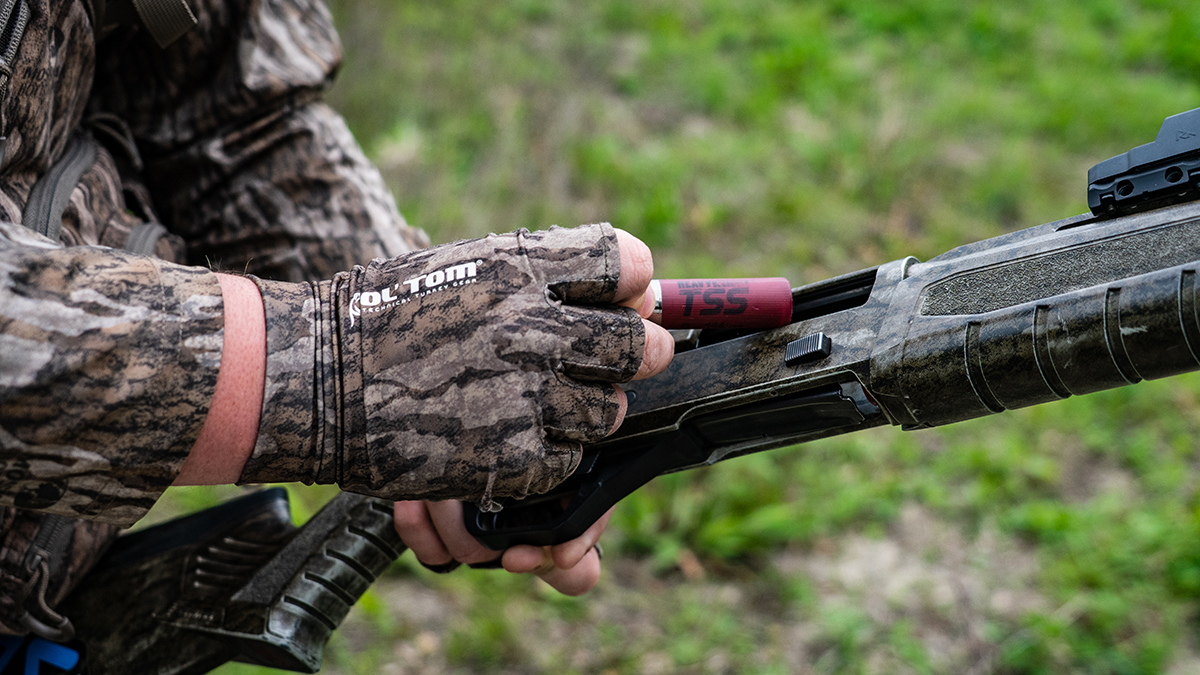
Tungsten Super Shot (TSS) is an ultra-dense tungsten alloy material. Choose TSS turkey loads and you can shoot a smaller shot size and pack more pellets into your payload while retaining insanely lethal energy.
Another major benefit of TSS is that, because the pellets are so hard, unlike lead, they don’t deform when your shotgun goes boom. When you’re spitting a bunch of bent pellets out of your turkey gun, your pattern starts to go haywire while the pellets are in flight. Imagine a swarm of bees flying together trying to sting someone, and half the bees just drank a bunch of whiskey — that beautiful flight formation is going to get messy, and a bunch of those bees are going to fly off and miss the target. The same thing happens with lead pellets. You don’t have that problem with TSS. That even flight of the dense pellets means you can ethically extend your effective turkey killing range.
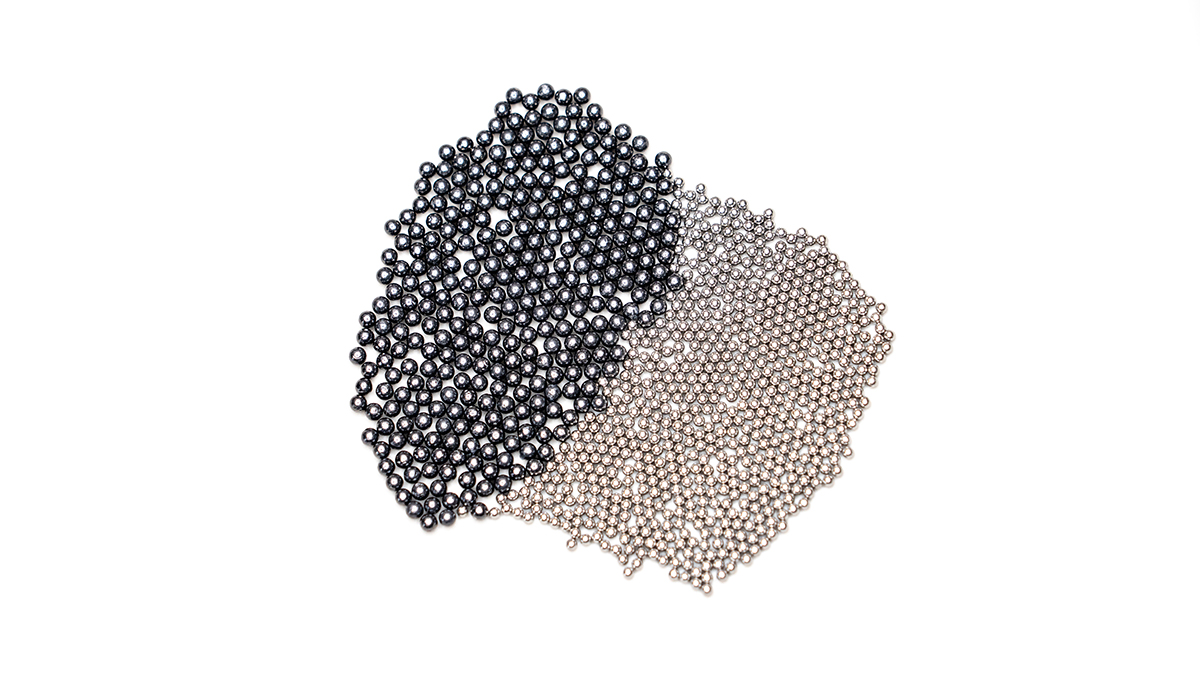
The "old standard" copper- or nickle-plated lead pellets (left) vs. Tungsten Super Shot TSS (right). No doubt, TSS is the superior pellet type for turkey hunting.
Remember, TSS wasn’t around when the old 40-yard standard was established for shooting turkeys back in the day. That said, you’ve got no business shooting turkeys much farther than 40 yards unless you’ve got a steady rest, a tried and true shot process, and a precision sight like a red dot. Oh, and by the way, you’re bound to run into a situation where you’re trying to kill a gobbler that’s hanging out with some other turkeys — so the last thing you want to be dealing with is a crappy pattern with pellets flying off course.
Plain and simple, TSS is a game changer.
Whether you’re sold on TSS or not, let’s roll into a patterning process that you can use to get more out of your turkey gun.
Finding & Hunting Terrain Features Turkeys Love
Variables in Turkey Gun Patterning
The two main variables in your patterns are going to be your choke tube and your turkey load. The more combinations of the two that you’re willing to test out of your gun, will land you in a better spot with your pattern.
Without going too deep into choke tubes, the main thing you need to know is that choke tubes come in a variety of constrictions. Just like the name suggests, a choke tube is choking down that payload before it leaves your muzzle. In general, what makes a choke a turkey choke is that it’s a pretty severe constriction, because turkey hunters usually want tighter patterns.
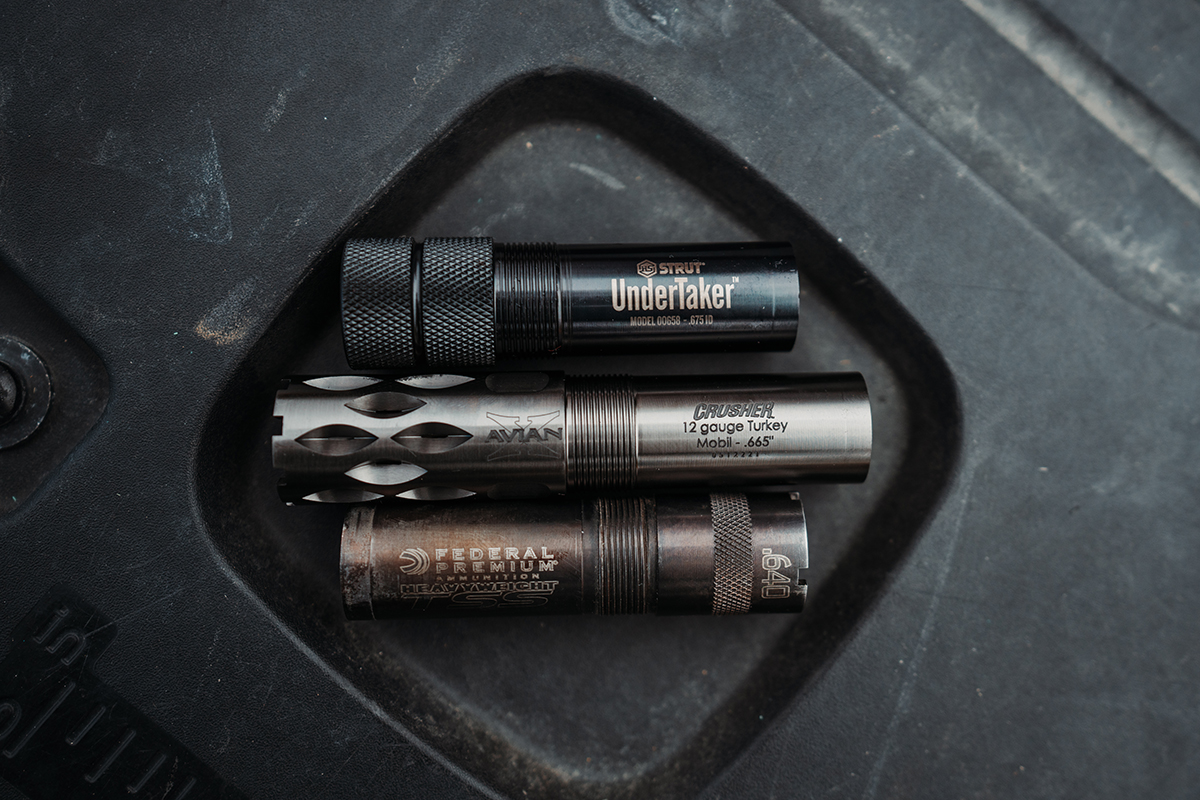
Ammo and choke tube selection will determine your patterns. Every combination will shoot differently, even out of the same model of shotgun.
Every turkey load is going to shoot differently out of every choke tube. Some constrictions work better than others. And not to overcomplicate matters, but truth is, even the same model of gun shooting the same load with the same choke tube can produce different patterns. At the end of the day, if you try several combinations out of your shotgun, you should be able to print a pattern that you’re happy with.
What should your pattern look like? That’s a personal decision, no different than what kind of camo you think is best in the turkey woods. Some turkey hunters strive for a super tight pattern, and others want a wider pattern to provide a margin of error for those rubber-neckin’ gobblers. A tight pattern will hold better at longer distances, but it can make it easier to miss when a turkey struts into your lap. A wider pattern is a happy medium, but this likely limits range.
This is why you pattern your turkey gun. This is your chance to experiment and ask yourself how you want your pattern to behave for your style of turkey hunting.
Alright, once you’ve got the choke tubes and turkey loads that you want to test, you need to make sure your gun is on paper. Just like a rifle. Usually, you can get pretty close shooting any kind of cheap shotshell. But here’s the key: To do this right, you need a large target area. A small 10- or 12-inch shooting target just won’t do the trick. You need to see where all the pellets are hitting. Saving or scavenging cardboard boxes is a cheap and easy way to come up with some patterning targets. In this case, I bought a giant roll of 4-foot wide paper from Amazon. To get on paper, keep the target close — around 15 yards is good. Adjust your sight so your point of impact matches your point of aim.
HuntStand Pro Tips for Last-Minute Turkey Hunting Road Trips
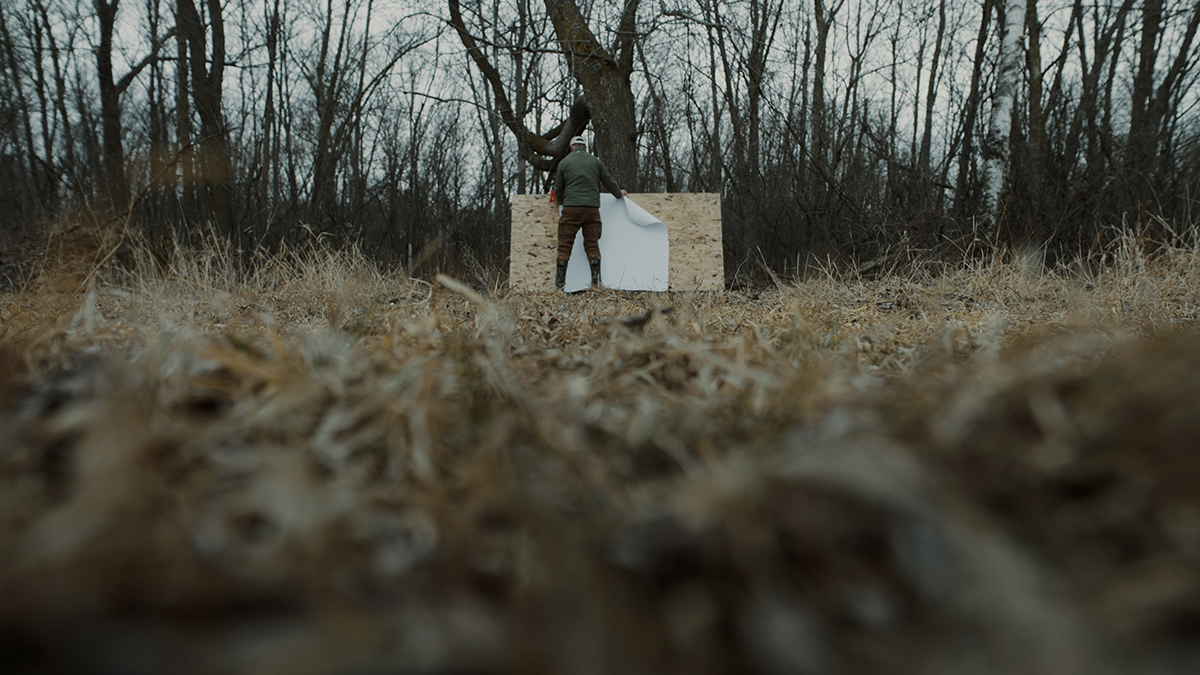
Start your turkey gun patterning process with a large target area to see the full pellet distribution.
Now it’s time to pattern your turkey loads. You’ll want to shoot all your different turkey loads through each of your choke tubes. Start with a fresh target area each time, and make sure to write the choke/load combo on the paper so you don’t lose track of what’s what.
This is a great opportunity to practice your shot process. It’s the same one to commit to memory by the time a gobbler is in your sights. It’s also important to have a steady rest. And, of course, make sure everything is safe. Wear hearing protection. Check everything downrange. Make sure the shotgun and choke tube are designed to handle the loads you’re shooting, especially if shooting TSS.
For patterning distance, we’re going to stick to that old 40-yard standard. And speaking of old standards, someone at some point decided you want at least 100 pellets in a 10-inch circle to have an ethical turkey load. I don’t know where that came from, but it seems fair. The important thing is you need enough pellets making contact with the gobbler’s head and neck to turn his lights out. Most folks agree about 8 pellets through the spine and skull will do the job. But when you’re even remotely serious about patterning, you can do a hell of a lot better than that.
Once you’ve shot all your patterns, it’s time to take a close look at each of them. Find the center of each pattern, draw a 10-inch circle around that center, and see what you’re workin with. Whether you want a super tight pattern or a wider pattern, ideally you don’t want a pattern with any big holes or gaps in the pellet distribution. If you want to get really fancy, do a manual pellet count.

Printing a respectable pattern on a turkey target is a sweet part of the turkey hunting process.
Choose your favorite pattern, and then rock and roll with the choke and turkey load combo that produced it. Then, sight in your turkey gun for that combo. Finally, it’s also a good idea to pattern your new setup at all the distances from which you intend to shoot gobblers, so you know exactly what you’re dealing with in the field. Turkeys will give you a run for your money most of the time, but a solid turkey gun will help to level the playing field.
Whitetails aren’t wired to move during daylight. First light, last light, and after dark are the times when you’ll almost always find the most deer activity. Because of this, they rarely make it far from their bedding areas during shooting hours.
That’s why it’s important to find staging areas to find more deer.
So, what’s a staging area? In short, this is a location between a bedding area and a destination food source where deer hang out until they feel comfortable emerging into the open. If you’re not hunting staging areas for whitetails, you’re missing out on what’s arguably the most consistently productive deer hunting, no matter the phase of the season.
UPGRADE TO HUNTSTAND PRO WHITETAIL
How to Identify Deer Staging Areas
Staging areas can have subtle differences, but in general it’s easy to identify a staging area no matter where you’re hunting. Find a bedding area, and then peel apart the layers outside the bedding area to figure out where the deer are likely to hold up prior to making their evening journey. A staging area will typically have a moderate level of cover, while offering quick escape routes to thick security cover — which is often the same as the bedding area. Staging can be a solo affair, but several deer will often congregate and socialize in staging areas.
You can use HuntStand to find likely staging areas by sorting through multiple map layers. Look for thick cover that transitions into more open cover. Sometimes this will be an obvious two-zone transition, or in other cases (like in the staging area featured in the video above) there will be multiple layers of cover butting up to a bedding area, and the deer could stage in any of these zones. As shown in the side-by-side map layer comparison below, HuntStand’s Monthly Satellite imagery can be money for discovering bedding areas. Toggle to the winter and spring months with the least amount of foliage, and you’ll quickly identify the thickets pockets of cover. Areas that remain thick all year — such as cattail sloughs or early successional habitat — will typically be primary bedding cover that holds deer 365.
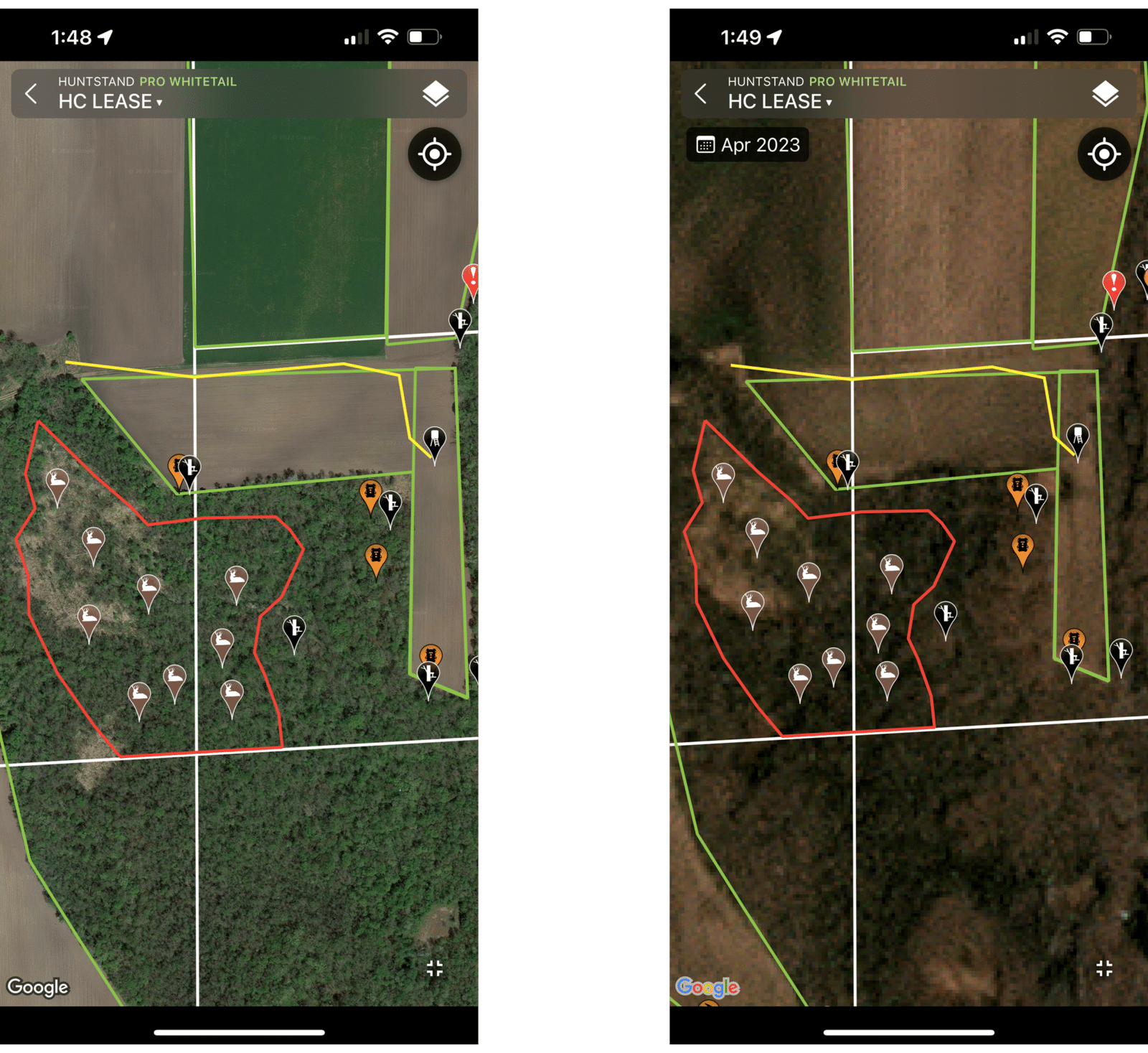
Then, use the aerial imagery to get an idea of destination food sources. A destination food source could be a food plot or an ag field, or even a bait pile or feeder — basically any considerable food source that whitetails won’t readily find in the woods. The Crop History map layer in HuntStand Pro Whitetail is a great tool for finding ag fields, and other high-resolution options like the National Aerial Imagery map layer make it easy to find food plots or smaller plantings. Remember, just because the food source isn’t on your property doesn’t mean your deer aren’t traveling to and from that buffet.
How to Hunt Deer Staging Areas
Once you learn to identify staging areas, they key is finding one that’s huntable. Vegetation needs to be manageable for you to have some shooting lanes. Also, whitetails are notorious for moving with their nose into the wind, so you’ll need to find a staging area that will allow you to effectively hunt a crosswind or a “fringe” wind. A fringe wind means setting up on the edge of the wind current so that your scent is blowing just off the path of your target deer. This can be a roll of the dice, but that’s why it’s critical to use the HuntZone wind map in HuntStand to properly approach, hunt, and depart from staging areas without being detected.
You can hunt staging areas all year, from early archery season into firearm season, and through late muzzleloader season. Prior to the uptick of rut activities, deer will tend to be on a somewhat predictable bed-to-food pattern, so catching them in staging areas can be a no-brainer. During the rut, bucks will swing through staging areas on the downwind side of bedding areas to scent check for hot does. Once the rut is over, eventually deer will resume their bed-to-food pattern just like the early season.
It’s natural to gravitate toward staging areas for evening hunts, but keep in mind they can be equally effective for morning hunts. However, pay close attention to trail cameras to get an idea of when deer are using staging areas during the morning hours. You’ll want to slip in well before they stack up for morning staging.
As security/bedding cover becomes more limited and hunting pressure increases throughout the year, finding a thick hellhole can be heaven on earth for a serious deer hunter. Do your homework and be waiting in a staging area with a cooler full of ice.
How to Build a Habitat Plan for Deer [Deer Dirt]
[Exclusive Offer Below]
We’re always on a mission to refine our hunting and shooting kits with the most efficient gear. Less clutter, more utility … that’s always the goal, right? One category that seems to be a constant struggle is in hearing protection, but it seems Walker’s just hit the mark with the new Disrupter earbuds. Watch the video above to get the lowdown on Disrupters.
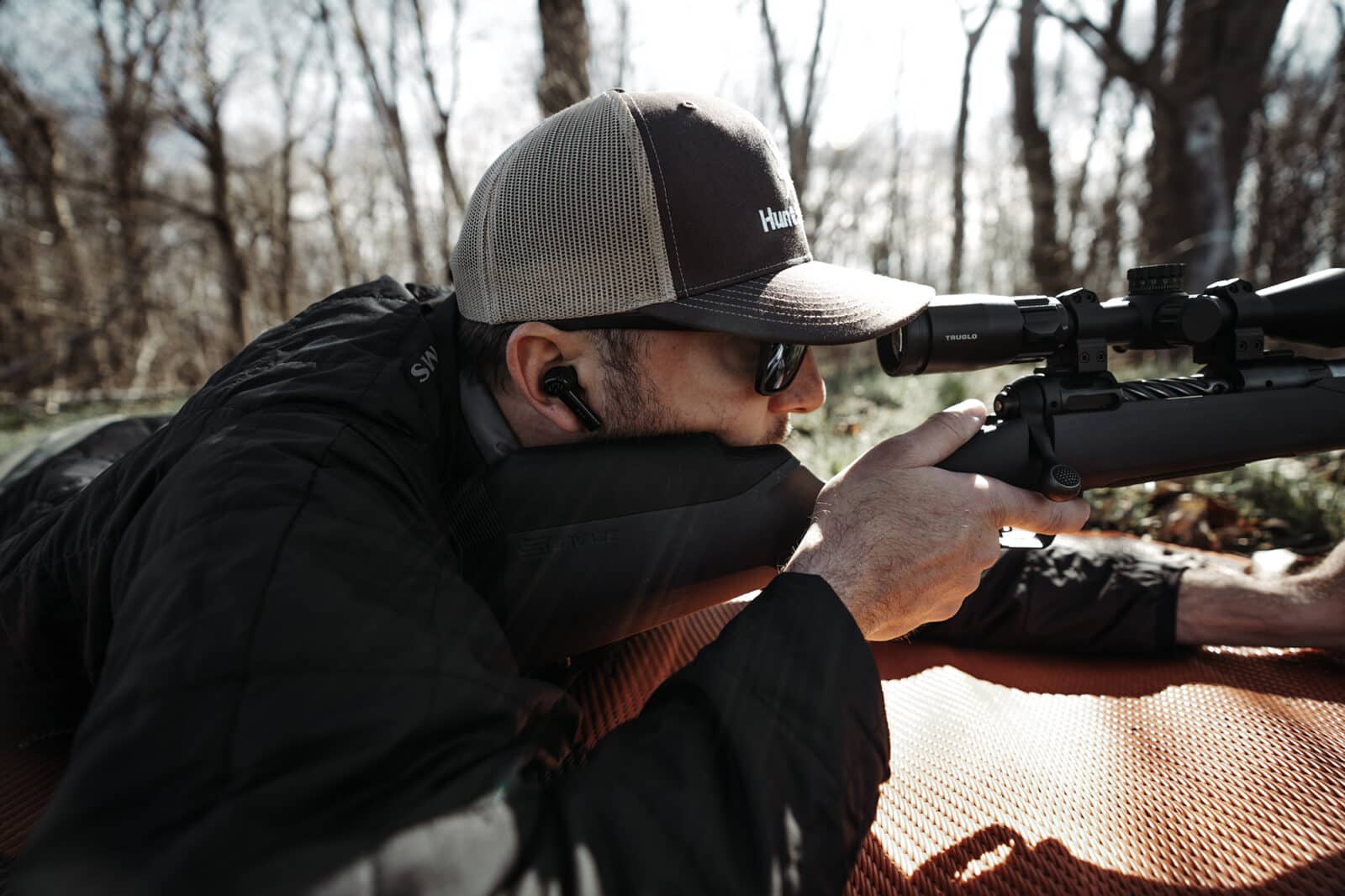
Walker’s has a long history of delivering innovative hearing devices, most notably by combining hearing protection with active electronic enhancement. The Disrupter earbuds step it up a notch as a full lifestyle solution, offering protection and enhancement along with bluetooth. This means you can answer phone calls, stream music, shoot guns, and detect sensitive sounds of game moving through the woods — all in one compact, rechargeable package.
HuntStand Exclusive Offer
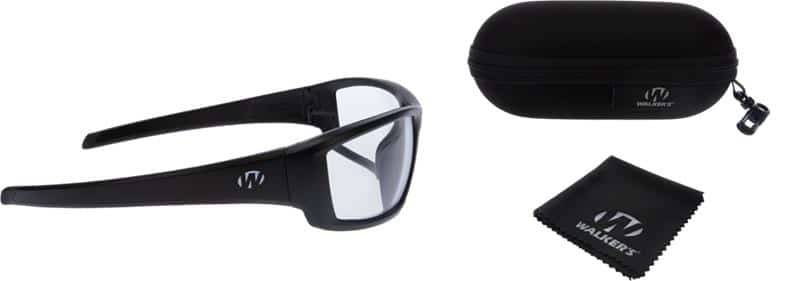
Order Disrupter earbuds now and our partners at Walker’s will throw in complimentary Ikon Vector glasses with a sleek carry case and microfiber lens cloth (package pictured above). Use code HSDISRUPTER at checkout to take advantage of this HuntStand-exclusive offer.
Note: Offer valid until Thursday, July 27, 2023. 1 per order. $24.99 value. Limited to Walker’s Distupter stock on hand.
Related: Eye-Opening Facts About Whitetail Hearing
The new Viper 430 crossbow from TenPoint Crossbows is a forward-draw crossbow with a narrow profile. Combine the 430-fps arrow speed with several new accuracy-driven modifications, and this crossbow is designed to produce tight groups out to 100 yards.
Our partners at TenPoint announced their full lineup of new 2023 crossbows this week, including a reverse-draw speed demon called the Flatline 460. These new crossbows are all sold as packages, with prices ranging from $1,749.99 up to $3,349.99. The Viper 430 is at the lowest end of that price spectrum, but as proven in my pre-release field test, it’s high on performance for a treestand whitetail hunter.
Viper 430 Crossbow: Initial Field Testing
In my line of work, it’s more the norm than the exception that I get a new hunting product in hand with little time to settle into it before a hunt. The Viper 430 landed on my doorstep midway through my Wisconsin crossbow whitetail season. At the time, I had been carrying the TenPoint Siege RS410 with great success (watch my first hunt with the Siege RS410). “If it ain’t broke, don’t fix it.” I’m a big believer in that mantra, but as a professional content producer it’s my job to be nimble and take on the challenge of getting new gear into the field at the drop of a hat. So, less than 24 hours before my biggest whitetail hunt of the year, I set up the Viper 430 during a frigid Minnesota fall evening and made sure it was dialed for the next morning.
If you’re new to shooting crossbows, they can take some getting used to. But once you become familiar with the basic mechanics of any crossbow, it’s much easier to grab a new one and get it ready for action. Within 3 hours, I had my new Viper 430 on the range and shooting lethal groups out to 40 yards. I’m sure the Viper 430 is capable repeatable 100-yard accuracy as advertised, and eventually I’ll get enough time to assess its full potential as a long-range crossbow. In the meantime, I was on a mission to pounce on a target buck that I’d been keeping tabs on for months.
On the morning of November 12, I climbed into a treestand and prepared for an all-day rut hunt. Deer activity was insane from the moment I nocked an arrow on my Viper 430. I caught a glimpse of “The Top Woods 8” at first light, but he didn’t offer a shot. After a nerve-racking couple of hours, the Wisconsin monarch sneaked in behind me on the heels of a hot doe. A classic cat-and-mouse showdown ensued, and eventually the Deer Gods offered me a shot on the cautious old buck. See the full hunt in this episode of Whitetail POSSE.
Standout Features of the Viper 430 Crossbow
You can get into the nitty-gritty tech specs on the Viper 430 crossbow right here, but I’ll share a handful of the features that stood out to me as an avid crossbow hunter.
I wasn’t sure how I’d feel about the “full-length” Viper 430, coming in at 33 inches long. I’d grown accustomed to shooting the ultra-compact, reverse-draw Siege RS410, which is undoubtedly handy for operating in tight quarters. Surprisingly, when I sat down to shoot the Viper 430, I was immediately impressed by how naturally it shouldered and came up to my eye. For most of the big-game season I call myself a rifleman, so the longer profile of the Viper 430 just felt “right.” Combine that feeling with the narrow width (6.5 inches full cocked), and it felt like a nearly perfect blend of balance and maneuverability once I was in my treestand. My target buck came in at an awkward angle, and I was dealing with a tree full of camera gear, but it was still pretty easy to finagle my way into a shooting position with the Viper 430.
Another benefit of a longer crossbow is the ability to keep it at the ready in a vertical position. You don’t always want to be holding your crossbow while you’re hunting. A longer crossbow allows you to rest it in a vertical position with the broadhead facing down, without making contact with the dirt or whatever you’re resting it on. You can’t do this with some shorter crossbows, where the arrow/broadhead goes past the bow hanger/foot stirrup. This might sound like a small consideration, but I can assure you it’s meaningful.
TenPoint built the Viper 430 with “scope struts” for added strength and rigidity, ensuring your zero will be maintained even if the crossbow takes some abuse in the field. The Viper 430 comes with a Rangemaster 100 scope, containing a reticle that’s optimized for long-distance shooting out to 100 yards. It’s a great optic for the Viper 430, but I chose to top mine with a Burris Oracle X—a digital crossbow scope with a built-in rangefinder. Acquire your target, press a button, and an illuminated dot shows you exactly where to aim. The Oracle X saves the extra step of using a handheld rangefinder, and I find that it helps reduce target panic.
Aside from the speed and stability provided by the Viper 430, another major contributor to this crossbow’s accuracy is the S1 trigger. As a two-stage trigger, it allows you to make contact with the trigger in the first stage before settling into the second stage to launch the arrow with a smooth trigger break. Two-stage triggers of this kind are especially helpful when you’re wearing gloves, so you don’t prematurely (unexpectedly) let an arrow fly.
Lastly, as is standard in most TenPoint crossbows, the Viper 430 incorporates the ACUslide cocking and de-cocking system. Loading or unloading your crossbow with the ACUslide requires minimal effort, plus it’s ultra quiet and safe.
CCI V-Max .17 HMR ammunition is an ideal rimfire cartridge/bullet combo for squirrel hunting. The polymer tip enhances accuracy and rapid expansion, making it easy to shoot squirrels with speed and precision. You’ll see this ammo featured in “Lookin’ Up,” a HuntStand Original Film.
Small game hunters benefit from shooting rimfire calibers to minimize meat loss. Rimfires are great for honing your rifle-shooting skills because of their low recoil and affordable ammo, and they’re an obvious go-to for plinking or killing pesky varmints.
CCI is perhaps the most reputable rimfire ammunition manufacturer, with a proven track record of consistency in both quality and availability. The company loads all the most popular rimfire rounds, ranging from .22 LR to the “magnum” .22s. In that lineup you’ll also find several variations of the venerable .17 HMR.
[lasso ref=”avantlink-28″ id=”33654″ link_id=”14446″]
Will Brantley, a devout squirrel hunting veteran, is a big fan of the FMJ bullets when trying to hunt squirrels with his .17 HMR. “I like ’em because you hardly lose any meat with a good headshot, or even with a lot of body shots,” he noted, referring to the fact that FMJs essentially pinhole the squirrels because they’re non-expanding bullets.
On the other hand, I had great success in the squirrel woods while shooting CCI V-Max .17 HMR ammunition. Being new to squirrel hunting, I quickly realized how tough the shots can be. The V-Maxes expand with the slightest resistance, so it’s a nice insurance policy when I don’t make a perfectly centered headshot on the squirrels.
Coming out of the barrel at around 2,500 FPS, you can expect sub-MOA accuracy from most CCI loads in .17 HMR … if you do your job behind the trigger. With a 100-yard zero, you can confidently take lethal shots on squirrels from zero to 100 yards with no concern about ballistic compensation.
The semi-automatic Savage A17 rifle is an ideal rimfire companion if your goal is to bag some bushytails. Staying on target for fast and accurate follow-up shots is important for squirrel hunters, and the A17 is built for reliable repeatability. Watch “Lookin’ Up,” a HuntStand Original Film, to see it in action.
Savage was the first to offer a semi-auto for the flat-shooting . 17 Hornady Magnum Rimfire (HMR). Popularity of the A17 has lead to a continuous line expansion, so now it’s easy to find a perfect model to match your rimfire pursuits. Whether you’re looking for a thumbhole stock, a lightweight synthetic stock, a heavy barrel, or other specific variations, Savage comes to the table with many unique options.
[lasso ref=”avantlink-24″ id=”33529″ link_id=”14373″]
The A17 featured in the video above is the A17 Sporter. It’s built on a sweet-looking Boyd’s gray laminated wood stock, providing a rigid platform that’s well balanced for continuous accuracy. Savage’s AccuTrigger makes it easy to adjust the trigger pull weight on your own (no need to visit a gunsmith). Another practical benefit of the AccuTrigger is its two-stage design, which forces you to make contact with the bladed portion of the trigger before finally squeezing through for a controlled shot. This is especially helpful if you’re wearing gloves, or trying to ease into the trigger when your hands are cold and numb.
What’s a repeater without enough rounds to work with? A 10-round rotary magazine in the Savage A17 gives you a solid cartridge capacity for target shooting or hunting applications.
LaCrosse is known far and wide as a category leader in rubber boots and rubber/neoprene hybrids, and now the brand is offering a whole line of lace-ups including the rugged Lodestar hunting boots.
Team HuntStand has collectively tested and trusted LaCrosse boots for decades, so the new Navigator series of leather hikers caught our attention from the get go. LaCrosse has earned longstanding respect in the hunting sector, so it only made sense that we’d eventually see an expansion beyond rubber boots—especially if you take into consideration that Danner merged with LaCrosse in 1994. The combined boot design and production experience between those two manufacturers is a force to reckon with.
LaCrosse Lodestar hunting boots sit on the premium end of the Navigator series. Vibram outsoles provide durability, stability and comfort in aggressive terrain, and GORE-TEX liners provide a waterproof barrier to keep your feet dry. You’ll also notice an aggressive tread pattern to give you more confidence on sketchy slopes, whether you’re traversing steep western shale or slippery southern mud.
Currently, you’ll find Lodestar hunting boots for men in uninsulated or 400-gram Thinsulate versions, and an insulated version for ladies.
[lasso ref=”avantlink-23″ id=”33510″ link_id=”14348″]
As shown in the video above, I recently wore the Lodestars during a squirrel hunt. Overkill? Nah. While these boots might be built for the extremes of backcountry big-game hunts, they proved equally suitable for hiking Kentucky’s hardwood ridges in pursuit of tree rats. Unlike more intense mountain boots, the Lodestars are lightweight and require minimal break-in, so they’re a solid choice for any active hunts that don’t require knee-highs.
If you’re already starting to look ahead to late-season hunts, when Mother Nature pitches a fit and gives you the cold shoulder, you should be plotting your cold-weather hunting boot selection. Here’s some advice from HuntStand Executive Editor Mark Melotik to keep you warm when it’s see-your-breath season.
After 2 days of turkey hunting in Nebraska, the POSSE crew closes in on a crafty gobbler. When the loud-mouthed bird finally reveals himself, the crew gets a SUPER surprise.
Pete Osterman used HuntStand Pro to find a likely roost area and a killable gobbler, but he had no idea what he was in for. Sleepless nights and a wild goose (er, turkey) chase ensued, and a hard-gobbling jake threw Pete for a loop.
WATCH ANOTHER NEBRASKA TURKEY HUNT FROM THE POSSE
Turkey hunt long enough, and encounter enough gobblers, and you’ll eventually learn that you can’t judge a turkey by his gobble. A mature tom can have a weak gobble, while a jake can have a thundering gobble that sounds like the oldest strutter in the woodlot. Keep chasing those gobbles until you know what you’re dealing with!
Even though Pete thought he was pursuing a longbeard, he was happy to tag what turned out to be the solo “super jake.” The bird nearly escaped, but the Aimpoint Micro S-1 red-dot sight helped Pete to get on target quickly and finish the job.
Turkey hunting in Nebraska is great for the traveling turkey hunter for a number of reasons. You’ll find plentiful Merriam’s, Rio Grande, Eastern and hybrid turkeys scattered across the state. Even better, a three-bird limit will keep you busy as you explore Nebraska’s state and federal public lands.
Last season, Pete and the POSSE headed to Wyoming to hunt Merriam’s turkeys in the Black Hills. Everyone managed to connect with beautiful longbeards during the 3-day adventure, but Pete came out of the hunt with the trophy gobbler of a lifetime. Click here to watch the hunt that produced a rare black-winged gobbler.
Butchering and processing your own deer enriches the hunting experience to a whole new level, giving you a much deeper appreciation for the spoils of a successful hunt. Maggie Carsello, like many others, has been waiting to pick up a blade and evolve from hunter to provider.
The field-to-table movement has swept across the country during the past decade, with more new and existing hunters self-identifying as meat hunters. Major organizations such as the Archery Trade Association and National Deer Association have recognized this movement as a critical tool for hunter recruitment and retention, launching several formal events and classes dedicated to training hunters on all aspects of wild game processing and cooking.
Have you ever considered trying the gutless method for butchering a deer? Watch this video and learn how it’s done. And after your deer processing mission is complete, go here for some tasty venison recipes.
SHOP FEATURED GEAR
WORK SHARP KNIFE SHARPENER
FEDERAL TERMINAL ASCENT AMMO
SAVAGE 110 ULTRALITE RIFLE
BOG DEATHGRIP CARBON FIBER SHOOTING TRIPOD
The Savage Impulse is the first all-American straight-pull rifle. See how it performs as a deer hunting companion.