





The Merriam's wild turkey is commonly referred to as the "mountain bird."
The Merriam’s wild turkey, carrying the full scientific name of Meleagris gallopavo merriami, abides throughout parts of the Midwest and West. It’s the mountain bird, as some call it, and for good reason. Many of these birds spent time at higher elevations. Of course, it requires hunters to travel to vastly different places than when hunting Easterns and some Rios. Here’s a complete guide for these loud-mouthed, high-pitched gobbling turkeys, including how to hunt Merriam’s wild turkeys.
About the Merriam’s Wild Turkey
The Merriam’s wild turkey is king of the West. It’s the mountain turkey, and it’s the most common of the subspecies in this region. The Rio Grande turkey is the second-most populated in the region. Easterns are the third.
The Merriam’s subspecies is sprinkled throughout the West. States with the largest populations include Arizona, Colorado, Idaho, Montana, Nebraska, New Mexico, South Dakota, Washington, and Wyoming. Other states with smaller pockets of Merriam’s include California, North Dakota, Oregon, Utah, and very small portions of others.
Don’t Miss: The Royal Slam
- How to Hunt Eastern Wild Turkeys
- How to Hunt Gould’s Wild Turkeys
- How to Hunt Merriam’s Wild Turkeys
- How to Hunt Osceola Wild Turkeys
- How to Hunt Rio Grande Wild Turkeys
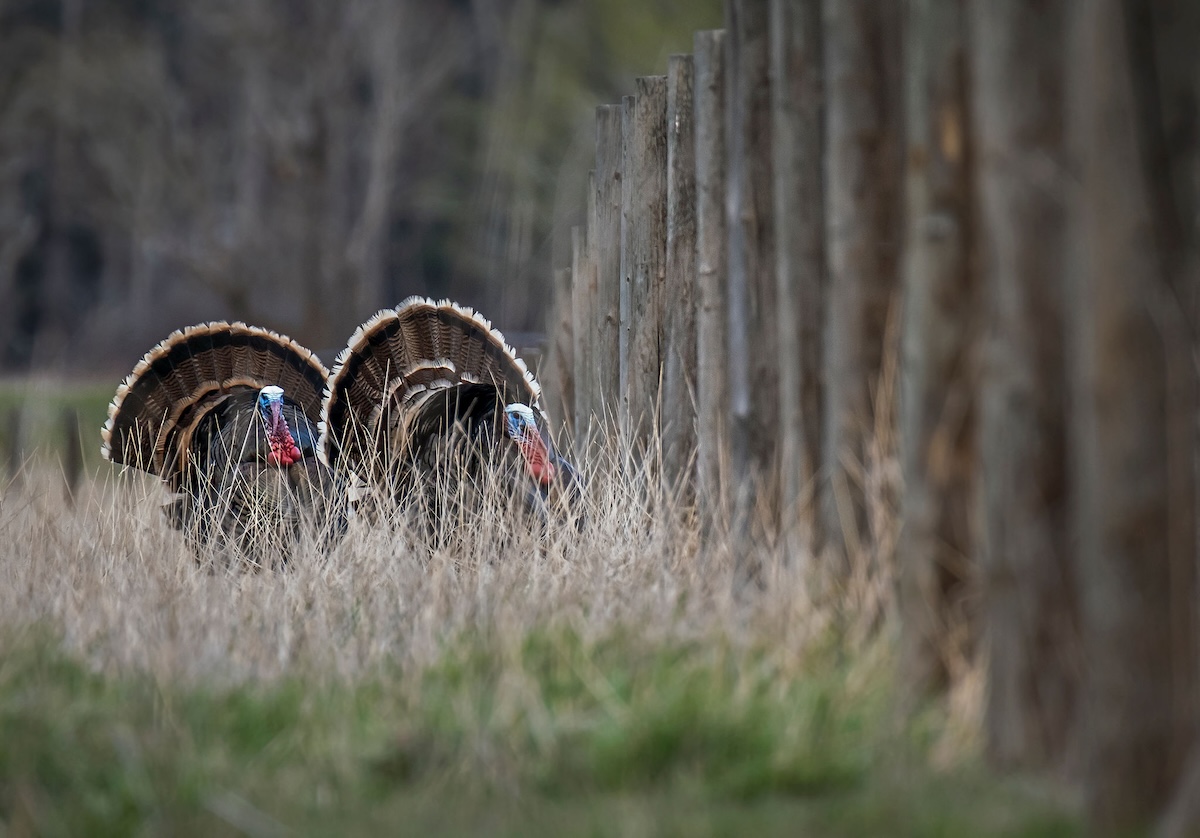
As you can see in this photo, Merriam's, Rio Grande, and hybrid turkeys often overlap and interbreed.
Merriam’s Biology: The Merriam’s is slightly bigger than Rio Grande turkeys, but smaller than most Easterns. Gobblers usually weight 18-25 pounds, with most being 20-22 pounds. Hens regularly weight 8-12 pounds.
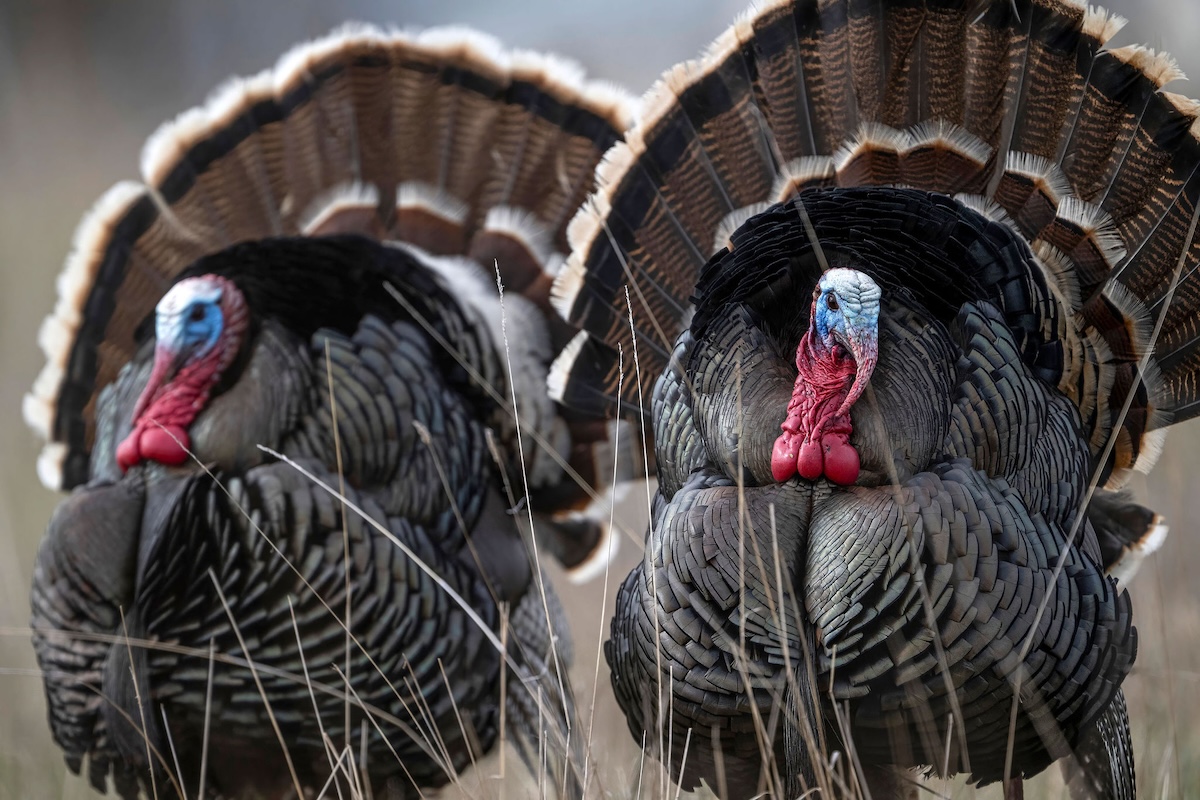
Obviously, the Merriam’s turkey differs in appearance from other subspecies. The Merriam’s is best known for its white-tipped feathers.
“The pure-bred Merriam’s tail feathers are probably the most obvious,” said Clayton Lenk, a district biologist with the National Wild Turkey Federation (NWTF). “It’s about as white as white can get. It has the frosted tips that are noticeably whiter than any of the other subspecies. Easterns are more of a chestnut brown.”
“They do have the shortest beard length of all the subspecies,” Lenk continued. “It’s the same with their spurs. You might find a 2 ½ to 3-year-old bird that just has nubs of spurs, which isn’t overly uncommon.”
Merriam’s Behavior: As for behavior, Merriam’s sound different than Easterns, Rios, and Osceolas. “Their gobble is definitely the weakest or laziest of gobbles,” Lenk said. “It just sounds like they’re not putting very much effort into it. They just belt out a noise.”
Also unique to Merriam’s (and some Rios), these birds are well-known for traveling great distances. In some areas, roost trees are limited. Thus, they can travel many miles in a day. Oftentimes, these routes are between key roost and feeding areas.
Merriam’s Habitat: Most Merriam’s turkeys are mountain birds. But some Merriam’s live in areas with prairie habitat. Lenk says to focus on places that offer mature trees for roosting areas. Wooded aspen, cottonwood, oak, pine and other draws and timber stands are excellent points of focus. Plus, if it has water, turkeys should be there.
Merriam’s Populations: Currently, most Merriam’s populations are doing well. Of course, these birds live in challenging landscapes. So, populations do fluctuate, especially after mild or severe winters. Milder winters tend to lead to better populations and severe winters tend to draw numbers down.
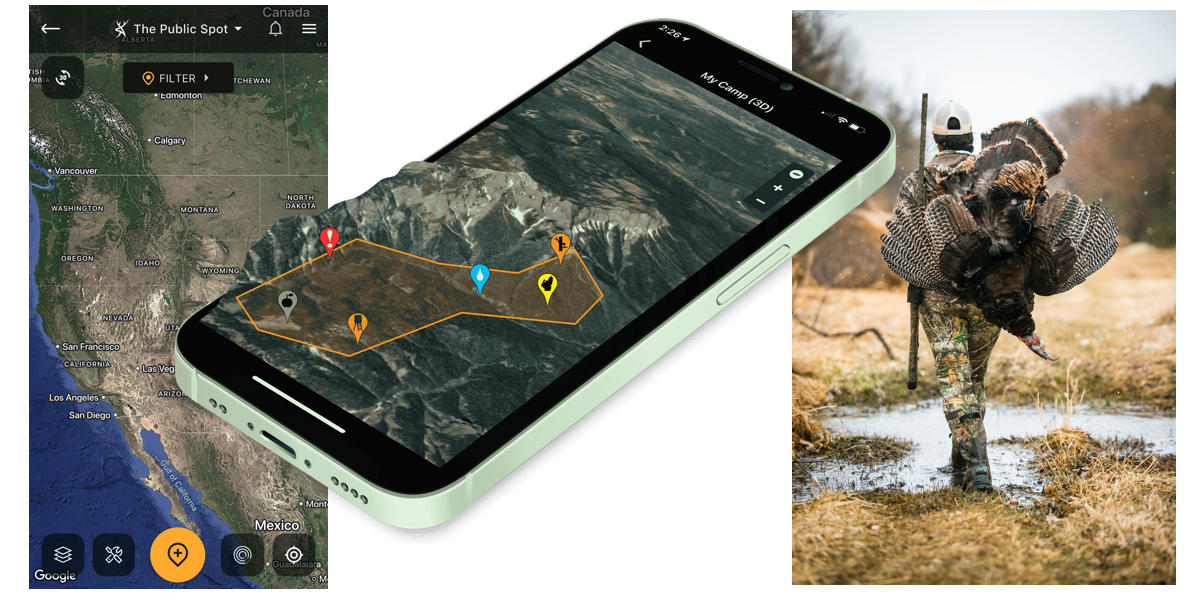
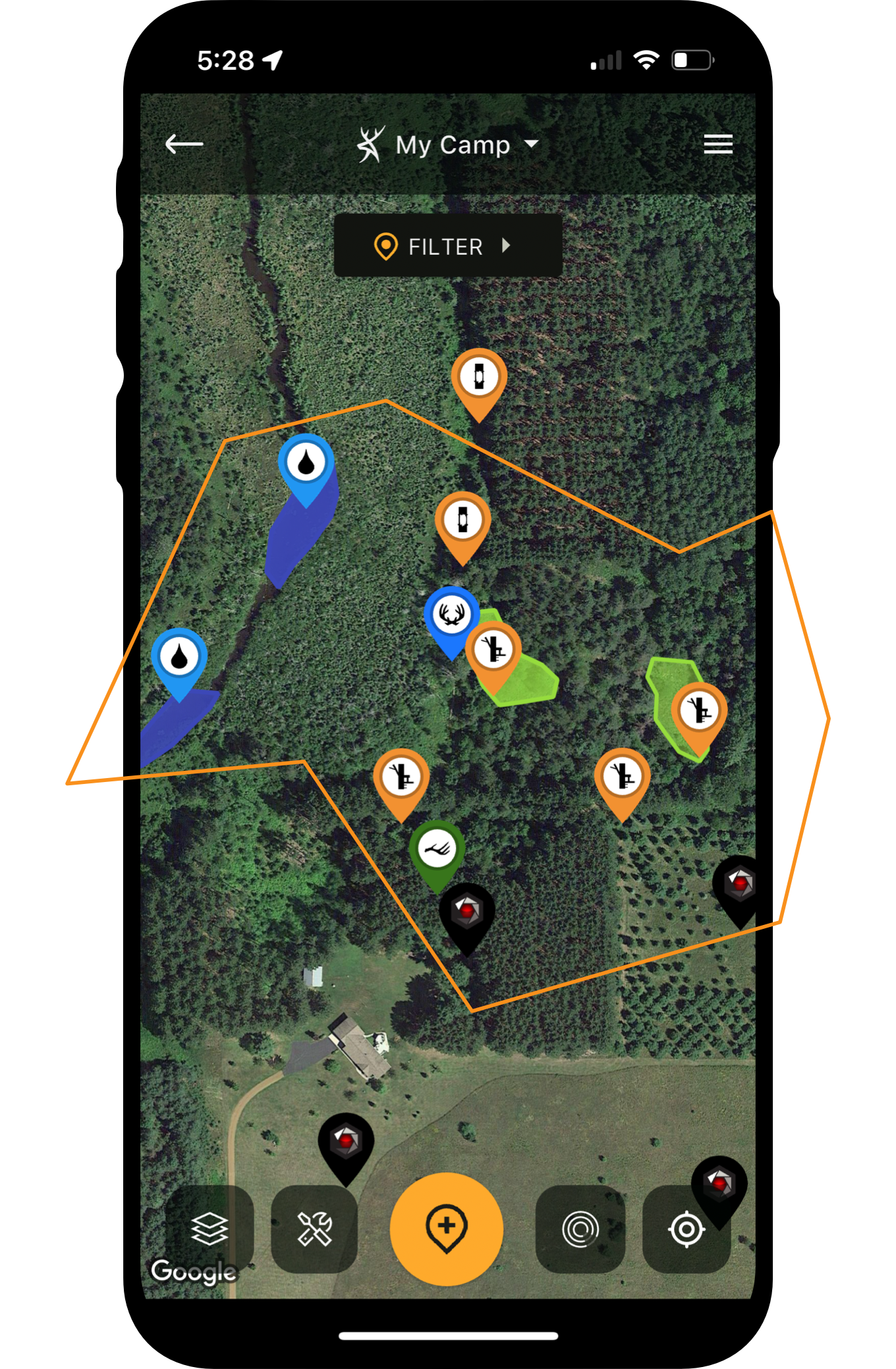
HuntStand delivers great layers and tools for scouting Merriam's wild turkeys.
Best Scouting Tactics for Merriam’s Turkeys
Some turkey scouting tactics are universal across all subspecies. Others are more unique to each one.
While hunting Merriam’s turkeys isn’t more challenging than Rios or Easterns, finding them certainly can be. In some instances, there are vast stretches of land void of turkeys between thriving populations of Merriam’s.
Furthermore, these birds cover a lot of ground. So, the key is covering a lot of ground yourself. Walk a lot of miles to find these turkeys. That said, don’t skyline yourself.
“Scouting is very important,” said Melissa Bachman, a HuntStand ambassador and hunting show host. “Do your homework ahead of time before the actual hunt happens. Ensure there have been no major changes on the land since last year. Make sure there’s still birds on the same properties. Most of the time, the birds do frequent the same areas, but every once in a while, they’ll move over to the neighbors. Or maybe they’re still bunched up.”
When it comes to topography, obviously a lot of Merriam’s are at higher elevation. That factors in. Sometimes, elevation change is in your favor. Other times, it’s in the turkey’s. When possible, use it to your advantage.
“With higher elevation, sometimes you can use some of that to your advantage,” Bachman said. “I like to use any sort of elevation in the area as an advantage. Get up high and watch. Do it just like any other big game hunt. Spot turkeys, watch what they’re doing, and figure it out.”
10 HuntStand App Layers and Tools for Backcountry Turkey Hunting
Of course, every good turkey scouting effort should start from a digital perspective. HuntStand Pro (and other subscription levels) offer excellent features that benefit the effort of scouting wild turkeys.
HuntStand offers numerous base layers, including the 3D Map, Monthly Satellite, Satellite, Mapbox Satellite, Terrain, and more.
- 3D Map: See and scout your hunting area in a realistic 3D manner. It’s a true-to-life look at the landscape. This is good for finding both habitat- and topographic-specific land features that turkeys love.
- Monthly Satellite: Study what properties looked like recently, or in the past. Observe month-over-month changes using the Monthly Satellite feature.
- Satellite / Mapbox Satellite: These are high-resolution 2D looks at the land. These offer great platforms for use of the Map Marker icons.
- Terrain: View the topography flow and changes without the distraction of habitat-based depiction.
Important overlays also benefit turkey hunters. Some of these include Contour, Hunting Lands, Public Lands, Property Info, etc.
- Contour: Add contour (topo) lines to base layers already being used. This adds another important scouting layer to your view of the landscape.
- Hunting Lands / Public Lands: Use these tools to locate potential public land hunting spots.
- Property Info: Find property locations by typing in landowner names. Or determine who owns property, as well as affiliated property and mailing addresses. This is vital information for gaining hunting permission and leases.
Other tools are highly effective for scouting turkeys, too. Examples include offline mapping, stand reservations, trail camera management, weather overlays, etc.
- Map Markers: Map marker icons are great for noting sightings, scouting discoveries, harvests, property attributes, and more. Turkey-specific markers to use include designated icons for dusting areas, feathers, feeding areas, gobbles heard, roosted gobblers, roosting areas, scat, scratching, setup location, strutting areas, tracks, wing tip marks, and more. Additionally, add important information, such as conditions, dates, details, photos, story details, and much more.
- Offline Mapping: A lot of turkey hunting hotspots don’t offer quality cellular service. At best, it’s spotty. Therefore, the Offline Mapping feature is crucial to maintain access to HuntStand, even when service fades out.
- Stand Reservations: Hunt club and lease members often use the Stand Reservations feature to reserve deer hunting spots on shared-access properties. That said, it’s a solid play for reserving turkey hunting spots, too.
- Trail Camera Management: Cellular trail cameras are excellent for deer and other big game. These are exceptional tools for scouting turkeys, too. With the HuntStand and Command Pro integration, keeping track of turkeys via cell cams has never been easier or more effective.
- Weather Overlays: Weather impacts turkeys and matters from a hunt planning perspective. Furthermore, turkey hunters are routinely eyeing clouds and trying to determine if it’s time to find cover, or if they’re brave enough to sit through it.
Once in the field, finding turkey sign is critical. Locate dust bowls, feathers, scat, scratching, strut marks, tracks, and more. These are indicators turkeys are in the area.
Important areas to scout include ag fields, bottomlands, food plots, oak flats, ridge lines, logging roads, trails and travel routes, and more. Don’t forget crossings, funnels, and pinch points, as turkeys routinely travel through these, too.
As for scouting methods, put boots on the ground, glass from afar, and post trail cameras. Most certainly, listen at dawn for potential roost sites and to take a pre-hunt gobbler inventory. Where legal, use a locator call (crow, owl, woodpecker, etc.) to encourage turkeys to shock gobble on the limb. Although less effective, this can be used to locate turkeys during the day, too.
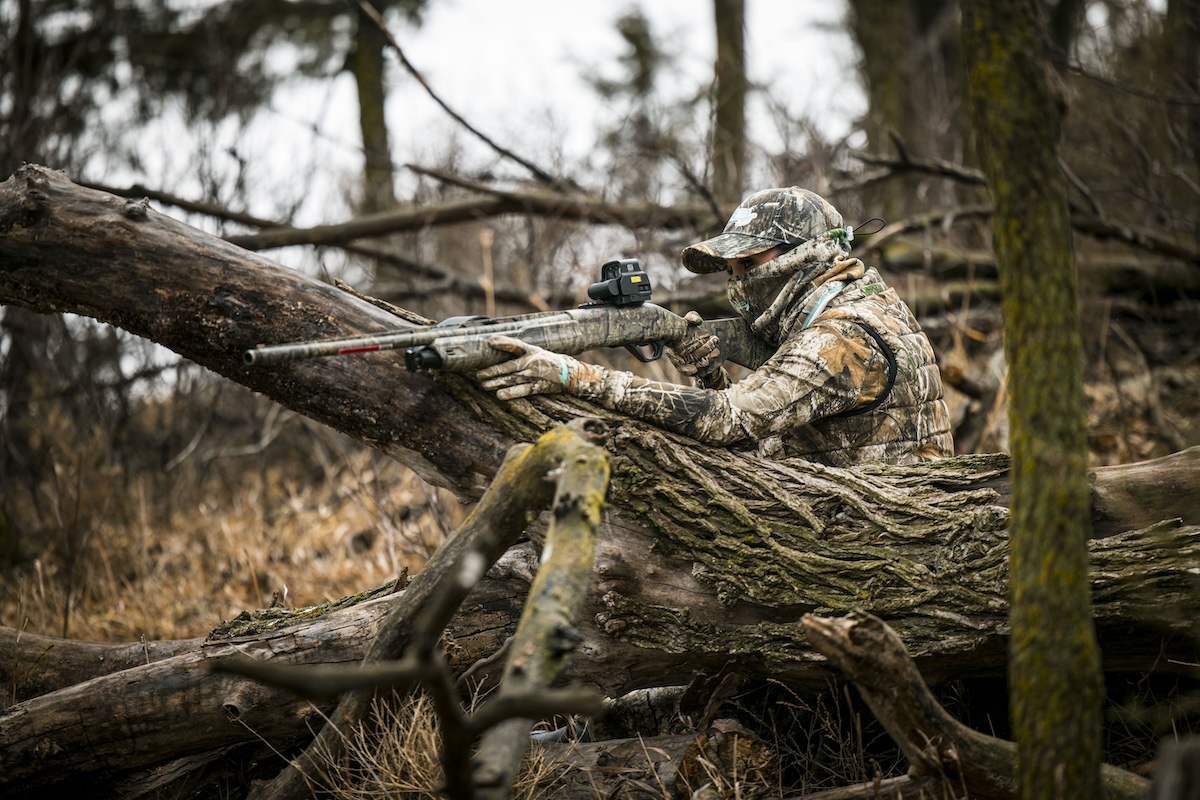
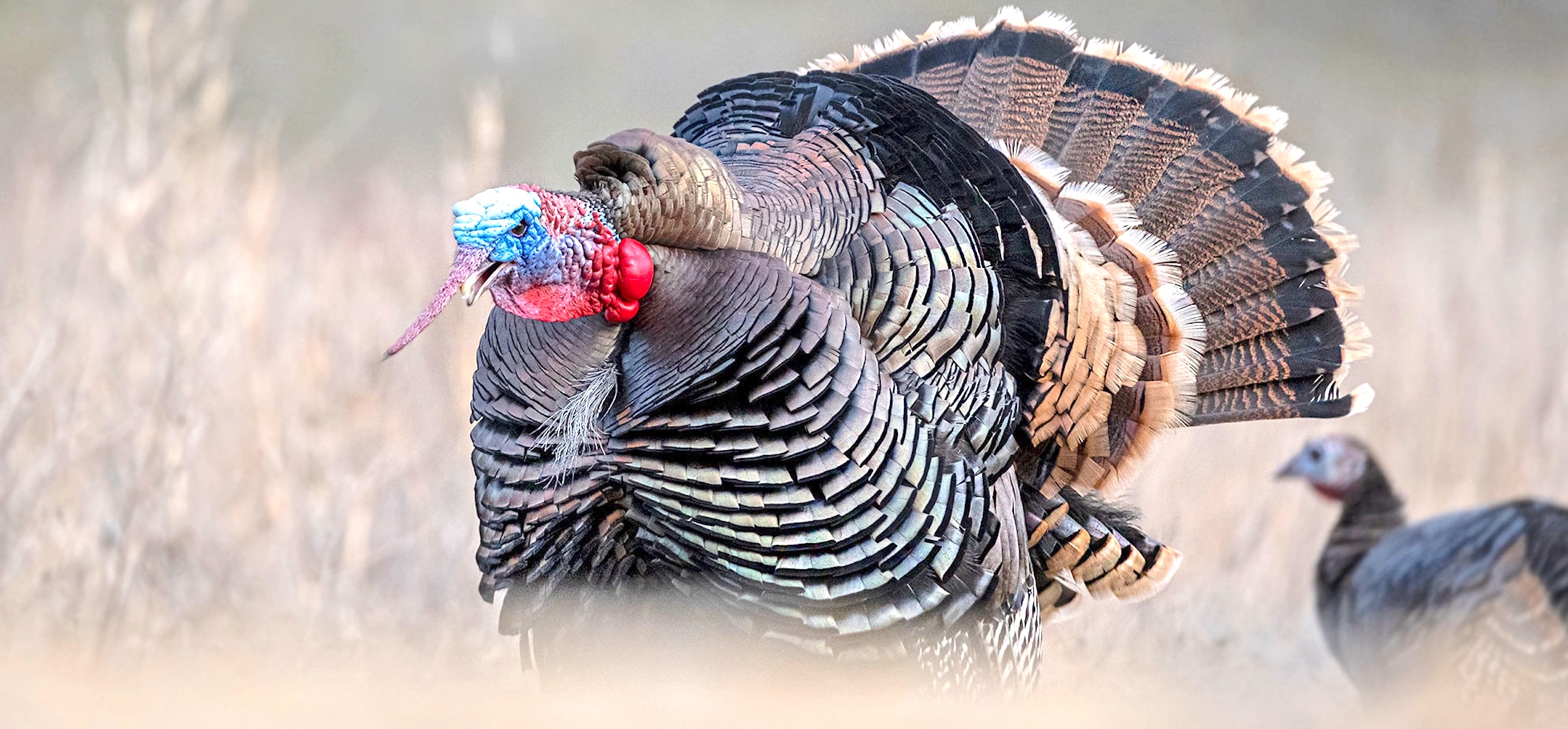
Calling in a Merriam's is much like other species, but they react to hunting pressure the same way, too.
Best Calling Tactics for Merriam’s Turkeys
As with scouting, some calling tactics apply to all subspecies of turkeys. That said, Merriam’s live in a unique setting with circumstances and conditions far different than other areas of the country.
Here, strong winds and varying topography can make hearing more difficult. Thus, use strong locator calls to reach the ears of these white-tipped birds.
Although Merriam’s are more widespread than Osceolas, these turkeys are more unique and more difficult to access. Because of this, some of these populations are highly pressured.
“If they’re heavily pressured, it’s important to not call too much,” Bachman said. “A lot of times, we do less calling. We’ll get up high and see what they’re doing.
“A lot of people are interested in hunting, and it’s getting harder to find places,” Bachman continued. “So, we do a variety of different hunting. One of the biggest challenges is finding birds that haven’t been as pressured. I’ve seen it where you start calling, and all of a sudden, those birds turn and run the other way. It just depends on how much pressure they’ve had. If dealing with birds that have been educated, you have to take each situation, learn, and adapt.”
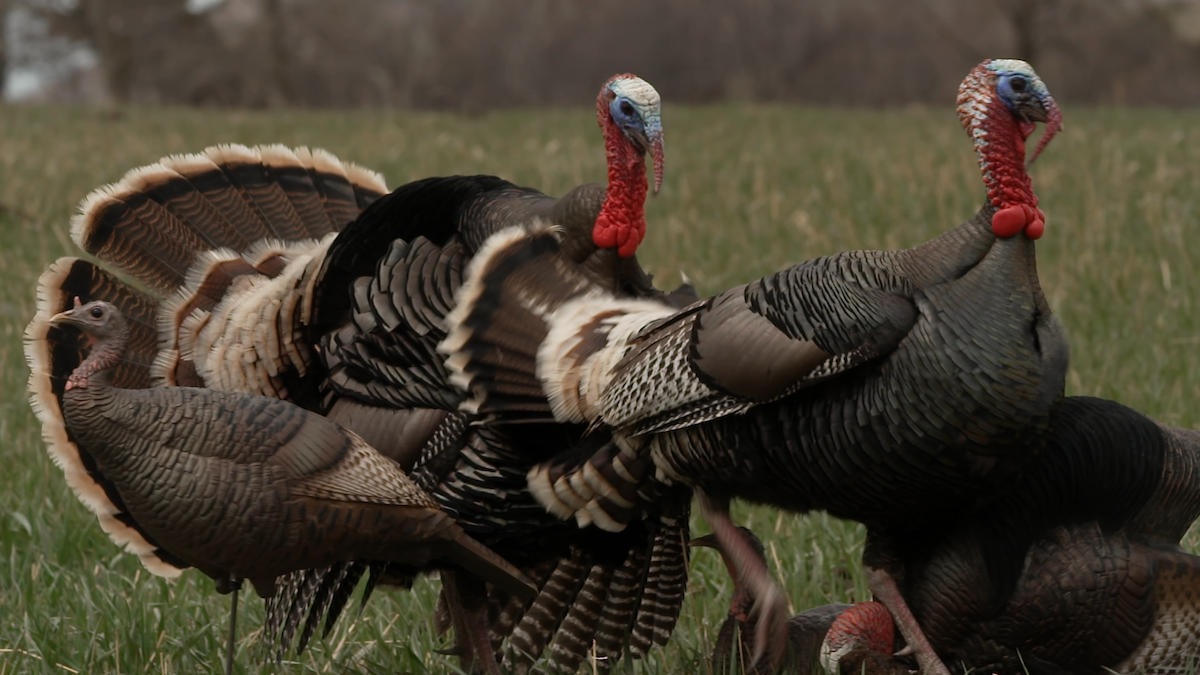
Merriam's are just as apt to charge in to a decoy spread.
Best Decoying Tactics for Merriam’s Turkeys
Most decoying tactics that work for other subspecies are viable for Merriam’s. Unless heavily pressured, these birds react quite well to decoys.
Whatever the decoy spread, consider deploying decoys in locations they can be seen from a distance. Because slopes and mountains are common, position decoys in locations where they have more potential to draw in birds from afar.
“We’ve had really good luck fanning them as well,” Bachman said. “We’ll go in, get close, pop that fan up, maybe give a few calls, and bring them right to us. That’s been very effective.”
Of course, if fanning, do this carefully and with safety measures in mind. Don’t fan on public land. Also, don’t fan on properties where other hunters might be nearby. Furthermore, don’t fan in thicker cover. Only fan out in the open. The list goes on.
Overall, because hunting Merriam’s requires a lot of walking, consider a good turkey vest that fits one or two decoys in it. (But keep the decoy bag tucked in your vest for when you shoot that bird and need to pack out the harvested turkey in the back of the vest.)
The Best Turkey Hunting Spots (and How HuntStand Pro Finds Them)
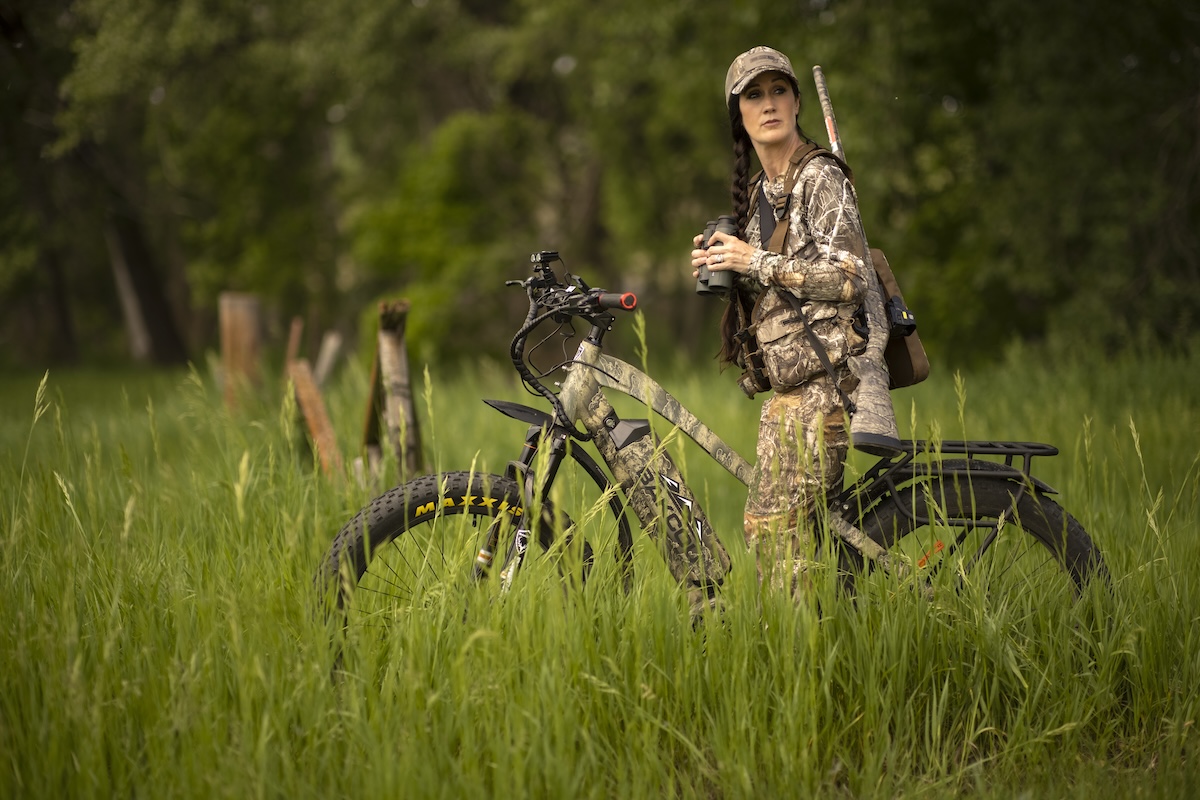
E-bikes are excellent tools for covering expansive Merriam's ground in the West.
Best Hunting Tactics for Merriam’s Turkeys
Hunters have many hunting tactics at their disposal. Of course, spend time glassing from afar. Merriam’s turkeys are known for long-distance travel. When you spot turkeys, move into position.
Find the Limiting Factor: In hunting, it’s always important to find the limiting factor. Generally, in Merriam’s country, that’s roost trees.
“You’re hunting them in the areas where you don’t have a ton of cover,” Bachman said. “I’m finding those roost trees. There might not be a roost tree for two miles. When you find them, you know, that’s obviously where those turkeys are.”
Ambush Close to Food: Determine where turkeys are feeding. Learn their travel routes from roost to feeding areas. Ambush them in known areas they frequent.
Sit a Ground Blind: A ground blind positioned in a good spot is a great play. It’s especially helpful on rainy days. Turkeys pay no mind to blinds, so you can pop these up just about anywhere and hunt. In the middle of fields is especially effective.
Run the Pendulum Play: This is for stubborn, hung-up toms. One hunter sits stationary. A second hunter drops back into cover and calls. When the gobbler swings left, the caller shifts right. When the gobbler moves right, the caller eases left. Hopefully, with each pass, that turkey gets closer and eventually walks within range of the shooter.
Deploy Creative Decoy Sets: Get creative with decoys. Use a breeding pair (jake and hen). Deploy a strutter with six or eight hen decoys (to mimic a flock).
Paint the Full Picture: Hunters can deploy additional efforts to convince a turkey they’re the real deal. Use a turkey wing and simulate the fly-down (alongside a fly-down cackle) or fighting (with fighting purrs). Add some movement to the decoy spread with a jerk string.
Target Satellite Toms: That boss tom isn’t leaving the hens? Target some of the satellite toms in the area.
Call to the Hens: Is there a boss hen with that dominant gobbler? Get her riled up. Mock her vocalizations, spark her to commit, and she’ll drag that gobbler along for the ride.
Be Patient: More than anything, just be patient. Give each setup more time than you normally would. Oftentimes, that bird will be there with another 30 to 45 minutes of waiting.
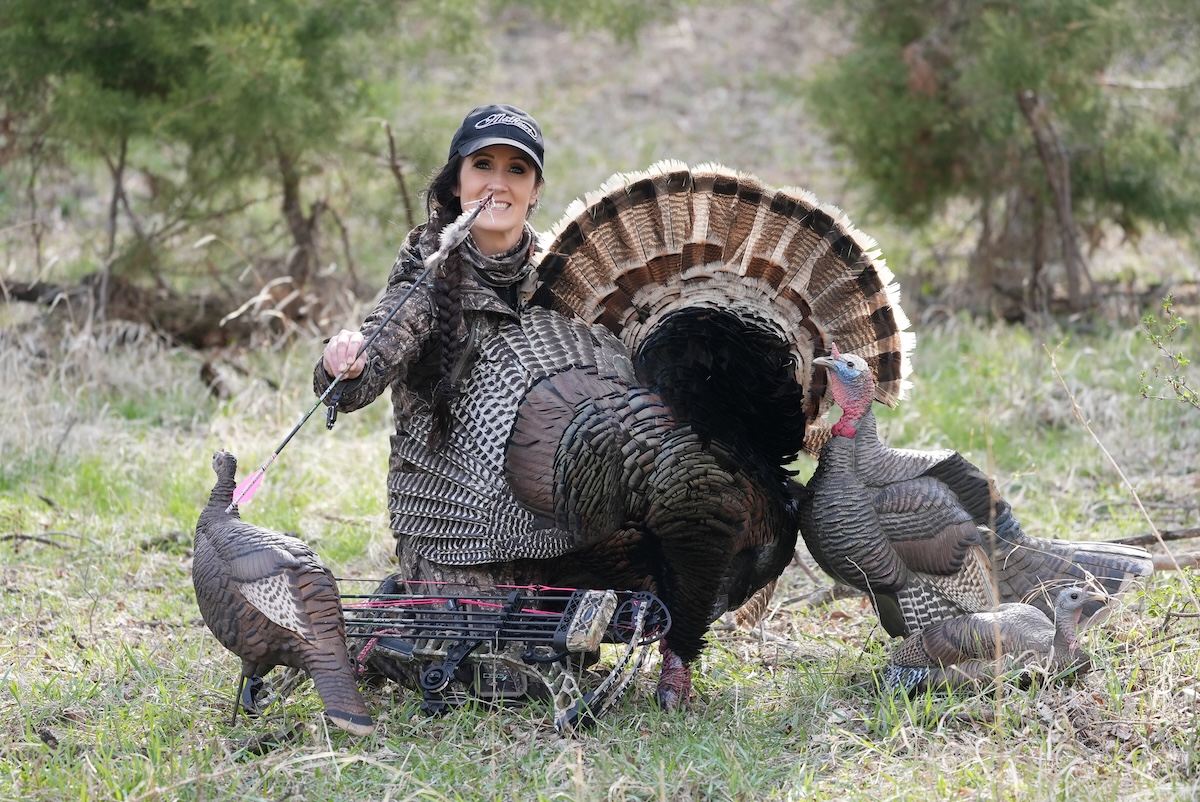
HuntStand's Melissa Bachman and a big Merriam's strutter.
Where and When to Hunt Merriam’s Wild Turkeys
As noted above, the stronghold for Merriam’s turkeys includes Arizona, Colorado, Idaho, Montana, Nebraska, New Mexico, South Dakota, Washington, and Wyoming. Other states with smaller pockets of Merriam’s include California, North Dakota, Oregon, Utah, and very small portions of others.
Early Season vs. Mid-Season vs. Late Season: The early season is characterized by larger turkey flocks, henned-up toms, aggressive gobblers, and vocal turkeys. The mid-season is known for gobblers being less henned-up and more responsive. The late season is known for strutters not being as henned-up and being less aggressive.
Early Morning: Turkeys tend to remain fairly close to their roost areas.
Mid-Morning: As the morning progresses, birds transition to destination feeding areas, such as ag fields, mountain meadows, or other localized and region-specific hotspots.
Midday: Midday tends to see turkeys retreating to cover. Oftentimes, this includes timber flats (oftentimes evergreens), or other open timber that provide shade and bugging opportunities.
Mid-Afternoon: Mid-afternoon might lead birds back out to fields and open areas. Some birds might remain in the timber, though.
Late-Afternoon: By late-afternoon, turkeys are shifting back toward their evening roost sites. They’ll feed along these travel routes and continue feeding until fly-up.
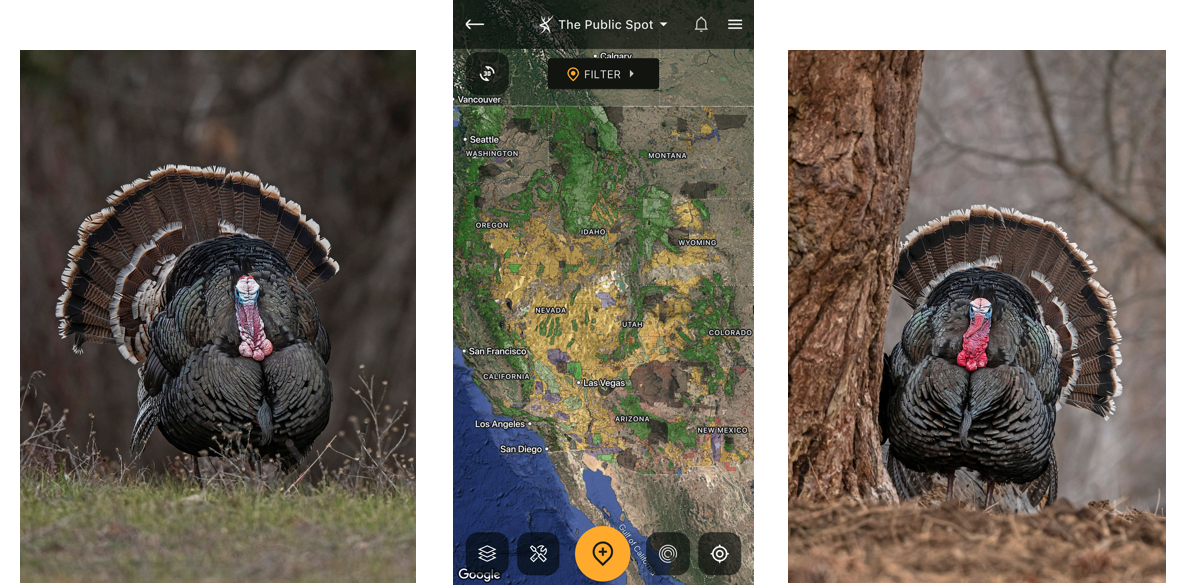
There is no shortage of public lands in Merriam's country.
Hunting Merriam’s Turkeys on Private Land
Some Merriam’s turkeys live on private lands. Of course, private land in the West is dominated by outfitters. To hunt Merriam’s on private land, this makes booking a hunt with a guide almost a necessity. Much like the Osceola, Merriam’s have a higher demand and moderate supply. So, land access can be tricky.
Hunting Merriam’s Turkeys on Public Lands
Much of the mountain West is loaded with public lands. Because of this, many Merriam’s live on lands that are open to all. It’s important to study maps of the Merriam’s population range, compare that to public lands, and select destinations that offer both. Furthermore, consult state wildlife agency websites for harvest data on public lands.
In a recent article, Jake Dahlke (brother of HuntStand’s Josh Dahlke) noted his conversation with public land hunters in Idaho.
“While in town at a local gas station, I noticed a jovial group of public land hunters with arms full of Red Bull and beef jerky,” Dahlke said. “I asked how the hunting was and one of them was quite proud to proclaim they tagged seven birds in four days. Based on this bit of gas station insight, it’s safe to assume the [public lands] holds a few [Merriam’s] turkeys.”
Mountain Merriam’s: Hunting Merriam’s Turkeys in Idaho
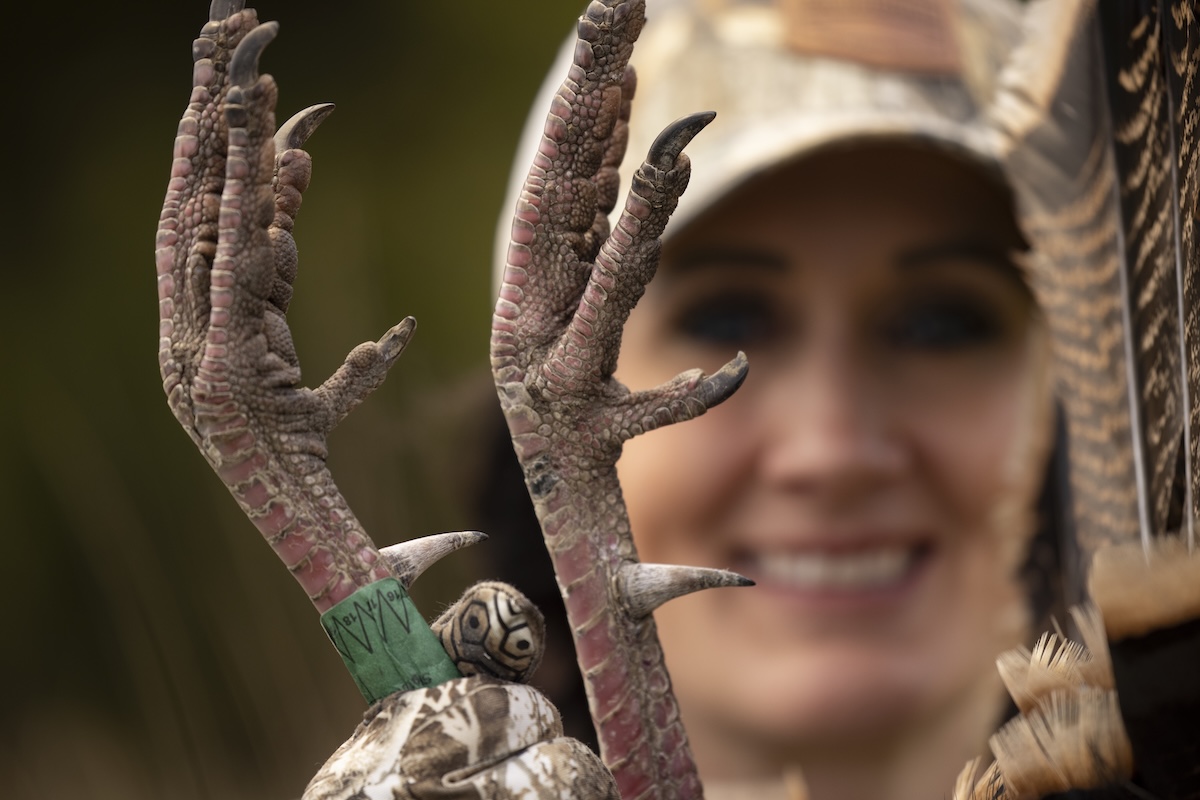
Try your luck on a Merriam's wild turkey hunt.
Go Hunt a Merriam’s Wild Turkey
Hunting the Merriam’s wild turkey is no simple endeavor. Finding the right destination is a big part of the struggle, as these birds are sprinkled throughout the West. That said, with a good scouting plan and hunting strategy, you’ll be seeing a white-tipped fan crest the hillside in no time.