





Midwestern turkeys offer unique adventures.
The Midwest: It harbors some of the country’s finest and most eco-diverse wildlife habitats. Often acclaimed as the world’s premier trophy whitetail destination, the Midwest also teems with wild turkeys and diverse opportunities to hunt them.
For example, the Great Plains states of North Dakota, South Dakota, Nebraska, and Kansas offer different birds and hunting opportunities than the more classic Midwest turkey states of Missouri, Iowa, Minnesota, Wisconsin, Illinois, Indiana, Ohio, and Michigan. In other words, there are several different flavors to choose from without leaving the Midwest.
Regardless of where you plan to chase Midwestern turkeys, this article is designed to expand your knowledge of the region, the turkeys that roam it, and the ways of success. From the different turkey subspecies to habitats to hunting tactics, and more, we’ll cover all things wild turkey hunting in the Midwest right here, right now.
- How to Hunt Northern Turkeys
- How to Hunt Southern Turkeys
- How to Hunt Western Turkeys
- How to Hunt Midwestern Turkeys
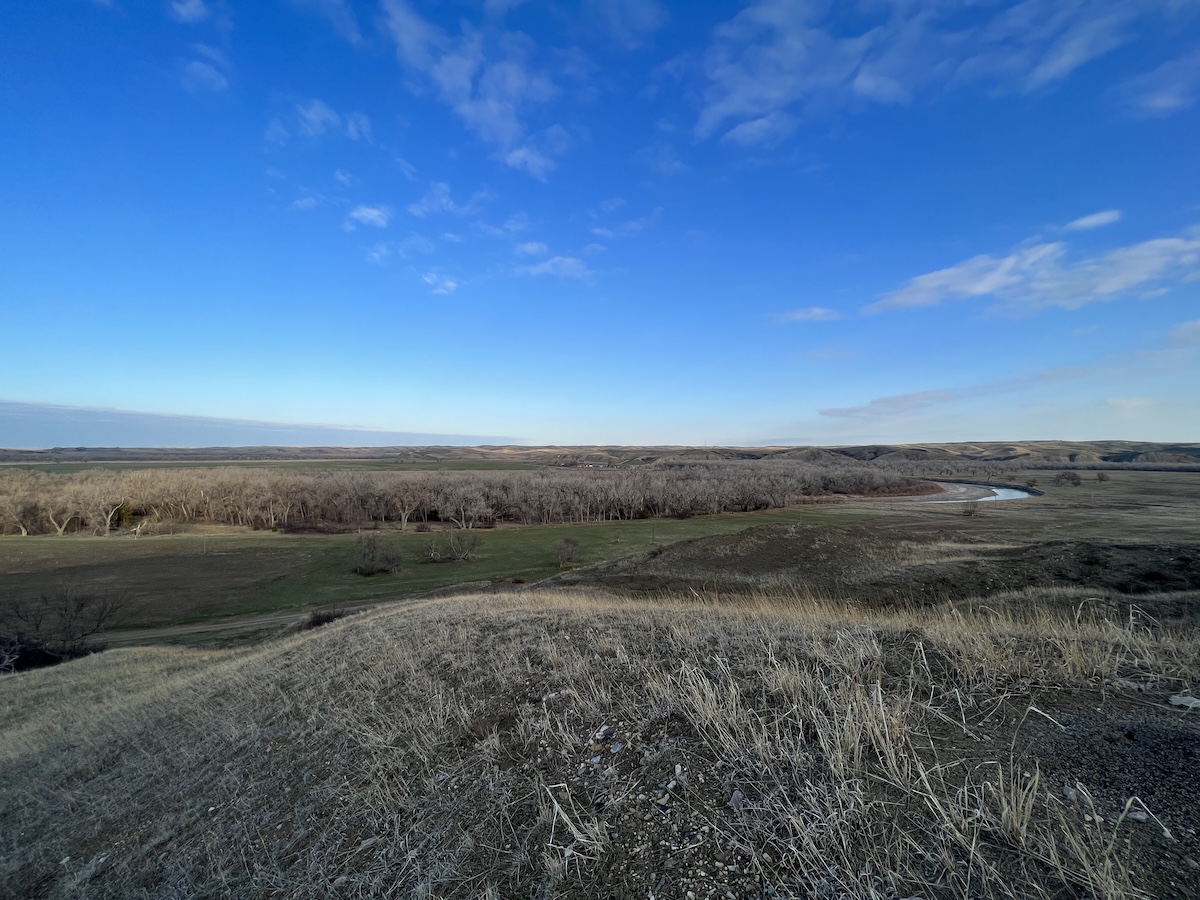
The Midwestern terrain is optimized for turkey hunting.
Turkey Subspecies in the Midwest
Most hunters associate Midwestern turkey hunting with big Eastern gobblers in the Illinois or Wisconsin timber, but other subspecies and habitats across the Midwest offer unique hunts. Clayton Lenk, a district biologist with the NWTF who covers several Midwestern states, said, “In the Midwest, we have Easterns, Rio Grandes, Merriam’s, and Hybrids between those three.”
Lenk shared an NWTF article that denotes each subspecies’ characteristics and a distribution map depicting their geographic whereabouts. We can draw the following summaries from those two resources.
Easterns inhabit a sliver of South Dakota, parts of North Dakota, eastern Kansas, Missouri, Iowa, Minnesota, Wisconsin, Illinois, Indiana, Ohio, and Michigan. This is the Midwest’s most sought-after subspecies because it dominates the region, and because the Midwest’s largest human populations overlap the Eastern’s range.
Easterns have the loudest gobbles and the longest beards of all the subspecies. Their wings sport white and black barring, and the tail-feather tips are Chestnut brown. Average Eastern gobblers weigh about 20-22 pounds, some heavier. Gobblers 3 years old or older typically have 1-1.5-inch spurs.
According to the NWTF subspecies distribution map, Rio Grande turkeys in the Midwest are concentrated in central and western Kansas and a few small pockets in South Dakota. Rios have weaker gobbles and shorter beards and spurs than Easterns. A Rio’s most distinguishing feature is his tan-tipped fan.
Merriam’s turkeys — arguably the Midwest’s prettiest subspecies — flaunt stunning white-tipped fans. Their weak gobbles resemble those of domesticated turkeys, and their beards and spurs are the shortest of all the different subspecies. In the Midwest, they’re most prevalent in South Dakota, west of the iconic Missouri River and in the Black Hills. They also roam north-central and western Nebraska and a small swatch of southwest North Dakota. These prairie and mountain dwellers weigh 18-22 pounds on average, but birds as heavy as 30 pounds exist. I once arrowed a 24-pounder in Cherry County, Nebraska.
Hybrids are crosses between Easterns, Merriam’s, and Rio Grandes. They dominate Nebraska’s northeastern and southwestern regions. Kansas also has Hybrid territory dividing its Eastern and Rio Grande populations. Western North Dakota also has Hybrid populations. Hybrid turkeys’ beards, spurs, gobbles, and body weights vary but are often comparable to the Merriam’s and Rio Grande, and fan colors vary from creamy orange to off-white.
Biggest Threats to the Wild Turkey
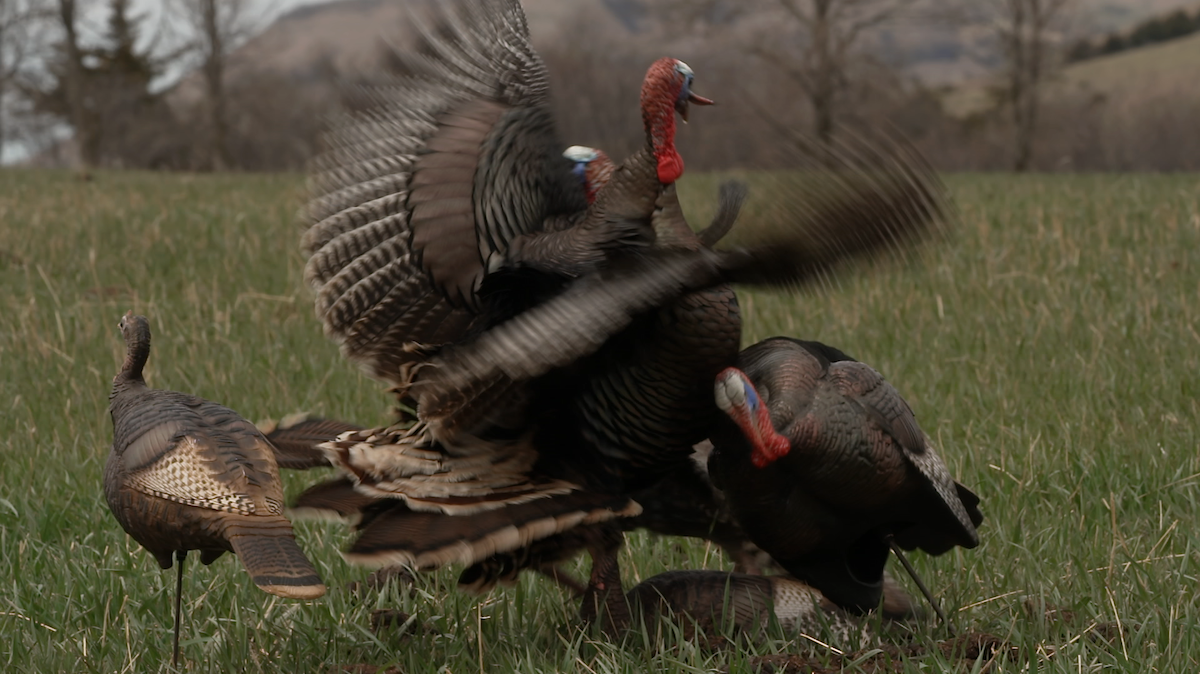
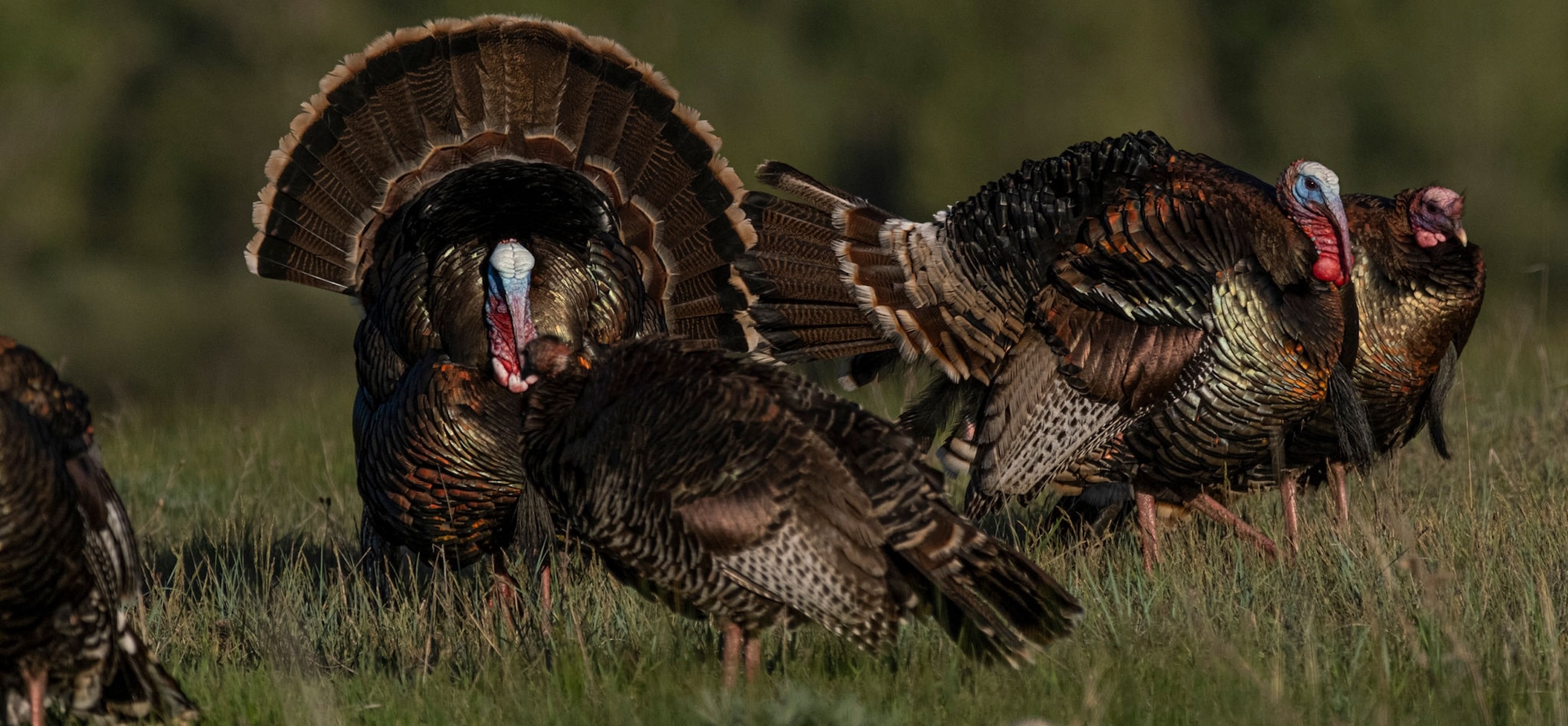
These Midwestern birds tend to have plenty of attitude.
Behavioral Tendencies of Midwestern Turkeys
The Eastern subspecies can be the most difficult to entice with calls, likely due to intense hunting pressure, particularly east of the Mississippi River. But, when one comes to the calls and decoys, he often does so with a purpose, making for a thrilling hunt. Most Easterns roam relatively small home ranges, as distances between daily necessities are short. This makes their roosting and feeding habits fairly predictable. Weather seems to depict their moods and behaviors in many instances.
Early spring flocks of Rios, Merriam’s, and Hybrids can range from 25-200 birds or more, and these are some of the mouthiest birds, even in snowy, unseasonably cold weather. Calling them in early in the season can be difficult, but they become quite receptive by mid-spring. Unlike Easterns, Merriam’s, Rios, and Hybrids are roamers and often cover miles daily to reach necessities, which are quite spread out on the Great Plains.
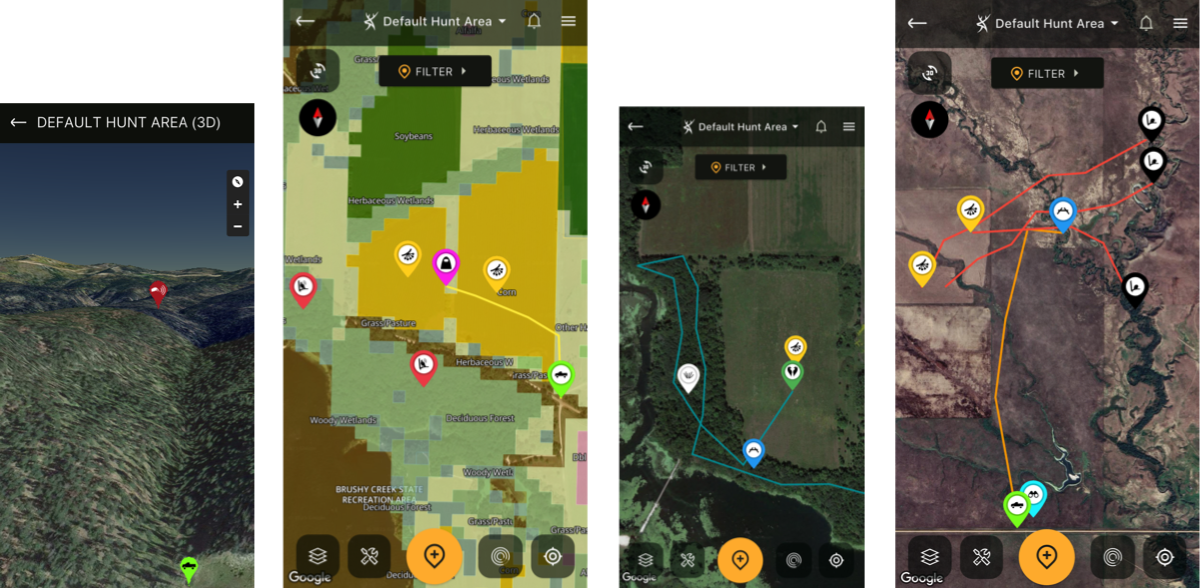
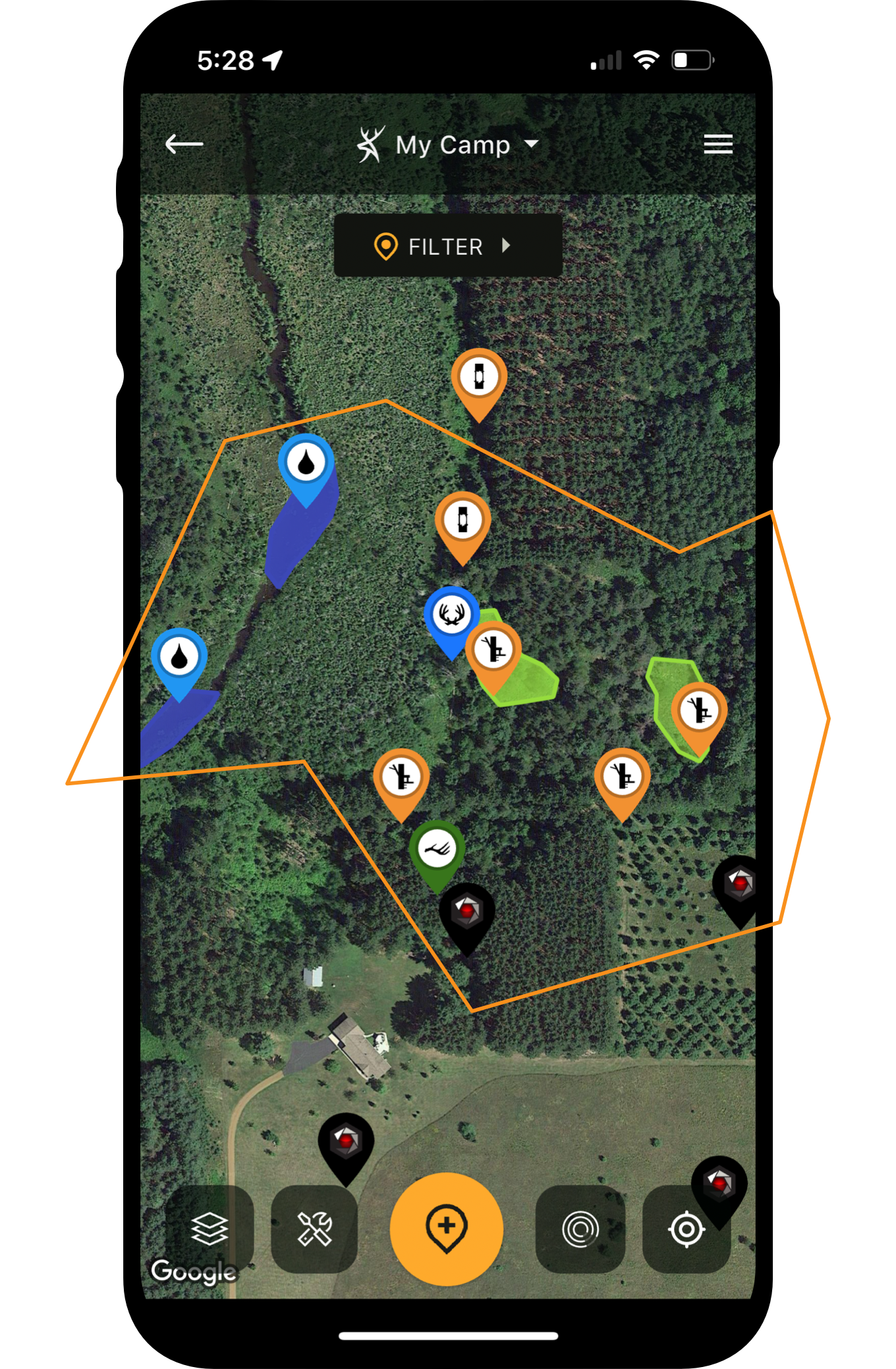
Use HuntStand before and during the hunt.
Midwestern Turkey Hunting Terrain
The bulk of the Eastern turkey’s range consists of timber, farmland, and riparian habitats. As for terrain, most is rolling, but some areas are pancake-flat, and then areas such as Minnesota’s Driftless Area feature wicked-steep bluffs. Prairie birds inhabit the flat plains, rolling prairies, badlands, and South Dakota’s cliffy Black Hills.
Utilize a few different HuntStand base maps and overlays to map your hunting area’s features. First, pay attention to agriculture, if present. In the Hybrid base map, engage the Crop History overlay to view color-coded shading over all agriculture. Click the “advanced” tab to see what crops were planted where in recent years. Turkeys love corn and soybean stubble, but they’ll rove through any open fields — even freshly tilled dirt — to strut and pick at clover, alfalfa, and bugs.
Next, gauge the terrain by switching over to the Terrain or Quad Topo base maps. In more extreme topography such as the Ozarks, the 3D map best represents the terrain you’re up against and will reveal high ridges from which to locate birds. Contour is a worthwhile overlay that displays typographical lines.
Riparian habitats, including creeks, rivers, and reservoirs, are easiest to identify in the Natural Atlas, Quad Topo, or Outdoor base maps, and these areas are often hot bets because of the water, roosting trees, and adjacent food sources.
Suitable turkey habitat is limited on the Great Plains, so engage the Tree Cover overlay to map out trees. Yes, turkeys will maraud the open prairies for bugs, but they must have suitable roosting trees. Although riparian areas are typically the most productive, small tree pockets amidst the otherwise open prairies can be dynamite. For example, I have taken several prairie turkeys in areas with so few trees that most hunters would drive right by.
Best Ways to Improve Your Land for Wild Turkeys
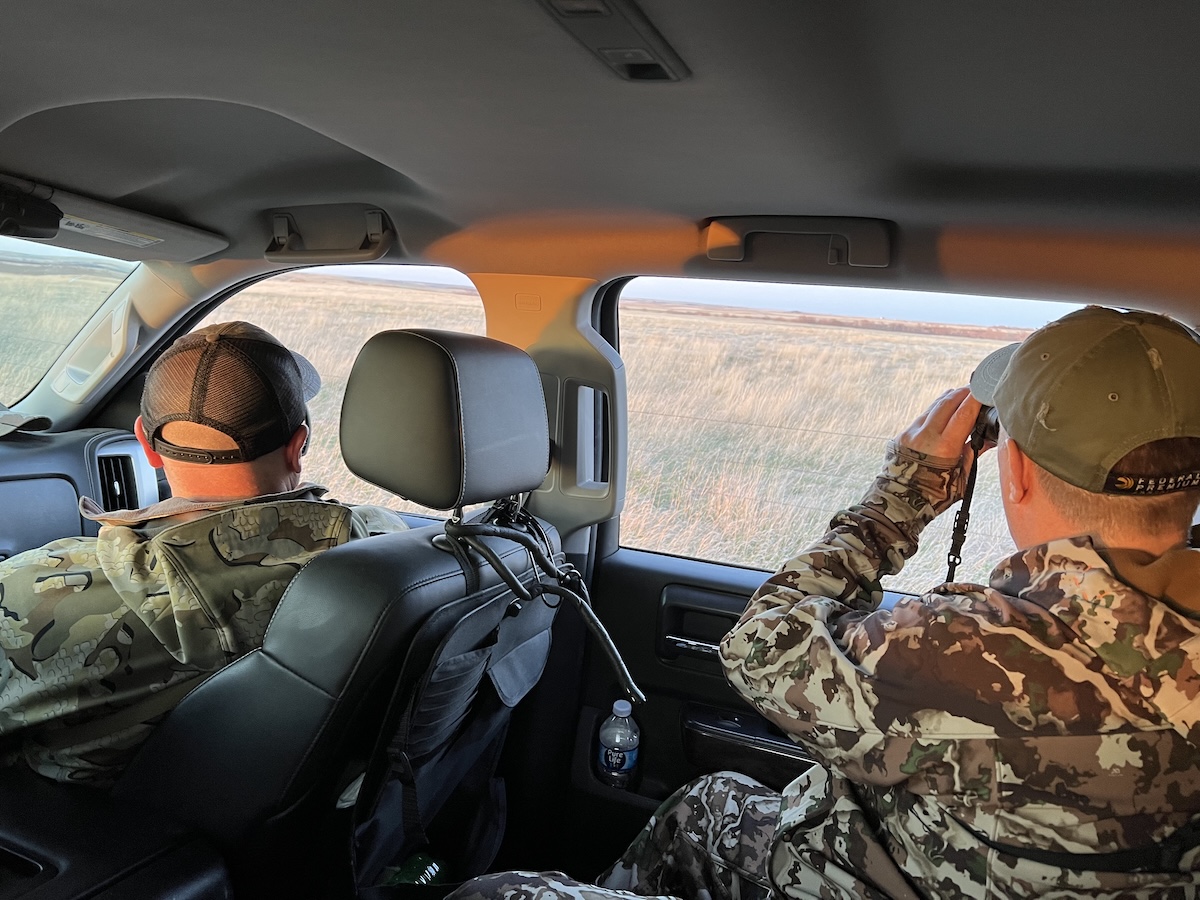
Glass wide-open areas for wild turkeys.
Scouting Midwestern Turkeys
The most consistent Midwestern turkey hunters scout thoroughly before hunting. While you can’t replace on-foot scouting, HuntStand Pro can inform your next steps.
We touched on habitat in the previous section, but let’s dive a bit deeper. Turkey survival requires three necessities: food, water, and roosting trees. This looks a lot different in western South Dakota than it does in Michigan, so let’s divide scouting into east versus west.
On normal spring days, Eastern turkeys are fairly predictable. They’ll roost in mature timber, feed in open or agricultural areas, then retreat to cool, shaded timber and a water source during the midday heat. As the heat subsides, they usually feed in open agricultural areas before slipping back to the roost. In HuntStand’s Hybrid base map, identify all fields and openings where turkeys might feed and drop appropriate markers, then determine adjacent mature timber and drop roosted turkey markers there as prospects. Then, mark nearby water sources. It’s that simple to peg a potential daily routine or several, which can inform your on-foot scouting.
When you head afield to scout, minimize your impact. Some of the most informative scouting entails listening at dawn 200-300 yards from potential roosting trees — remember, you marked these locations in the app. If birds aren’t gobbling, blow a boisterous crow call, hoot like an owl, or shake a gobble call. This can prompt a shock gobble, which discloses a gobbler’s location. A roosted tom’s gobble is an audible confirmation as to where he roosts. Make some calculated assumptions as to where he and his flock will feed once they fly down based on the agricultural areas you marked in HuntStand. Avoid walking around in open fields to scout. Instead, observe from a distance with optics to decrease your impact.
A lack of gobbling at dawn doesn’t necessarily mean that gobblers aren’t using the property (whether public or private) you intend to hunt. Even though Eastern turkeys roam a fairly small daily range, the terrain and timber density can squelch gobbling. Toms might be roosted not far away and will end up where you hunt later in the morning or midday. You can confirm that by searching the timber for droppings and strewn leaves. Study muddy trails and roads or sand bars and creek banks for tracks. Mark all signs you find in the app so that you can re-find it easily.
Hybrids, Rio Grandes, and Merriam’s turkeys demand a different scouting approach. Given the open habitat, binoculars and a spotting scope are essential. The Terrain and 3D maps can inform you of solid glassing points and knobs with commanding visibility. The tall prairies above cottonwood-lined creeks and rivers, for example, can help you peg a western flock’s morning and evening routines without intrusion. Even one morning or evening of long-distance glassing can hugely impact the following morning’s hunt.
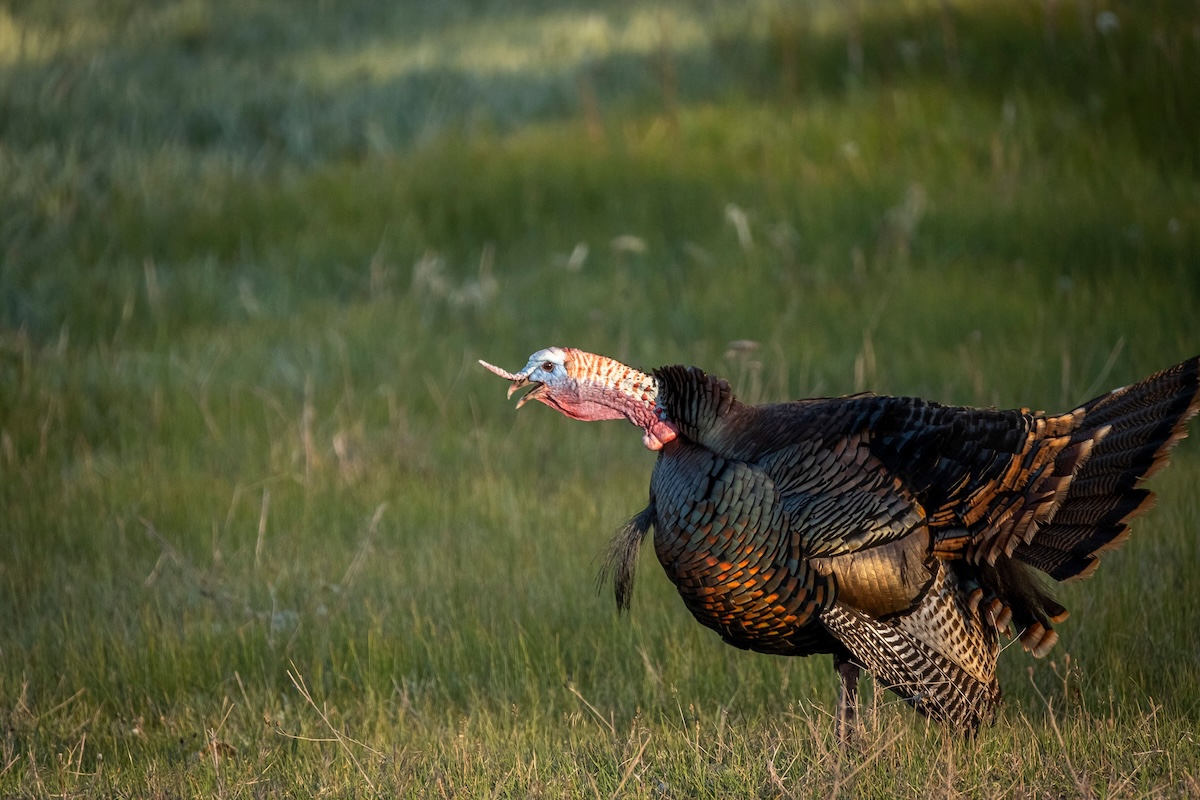
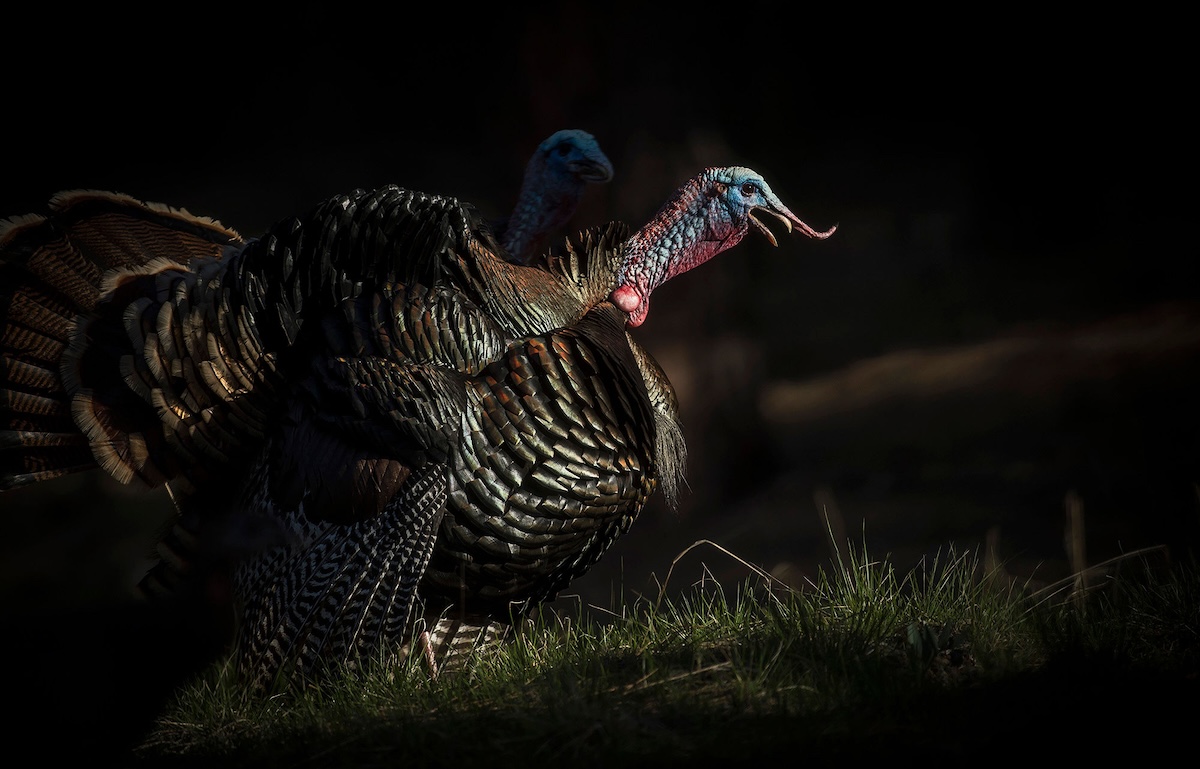
Get that bird to gobbling, and enjoy the show.
Calling Midwestern Turkeys
Because Eastern gobblers can be finicky based on weather and hunting pressure, conservative calling is often best. It becomes tempting to call incessantly when they’re rattling their heads off on the roost, but a few tree yelps usually suffice.
When they fly down, they’ll often come looking. If they don’t but are still gobbling hard, call more. If they’re responding but not coming in, call on and off for a minute or two, and then shut up. Often, their curiosity will build, and they’ll come looking. If not, resort to tossing leaves (if present) if the gobbler is within earshot. This is one of the deadliest calls for cagey old Easterns.
Mouth calls are some of the most effective for the Midwest’s tightest setups. Often, a bird coming and looking for you in the timber will hang up close by but just out of view or directly behind you. Reaching for a slate or box call will spook the bird, but a mouth call will allow you to coax him those final few steps without moving.
Of Minnesota birds, Lenk said, “Call enough to keep the gobbler’s attention but not so much that it makes him nervous or suspicious. The nice thing about turkey calling is that you don’t have to be an expert. A little practice goes a long way, and even a simple yelp is a great start for novice hunters.”
Prairie birds can be more receptive to aggressive calling. Due to windy conditions, loud calls, such as mouth and box calls, are typically the most effective. If a Merriam’s, Rio Grande, or Hybrid hangs up, you can almost always work the terrain and try a subsequent calling setup. Also, be attentive to hens responding to your calls. Get a hen talking, and then mimic her calls. Tick her off, and she’ll likely come in aggressively with a strutter following.
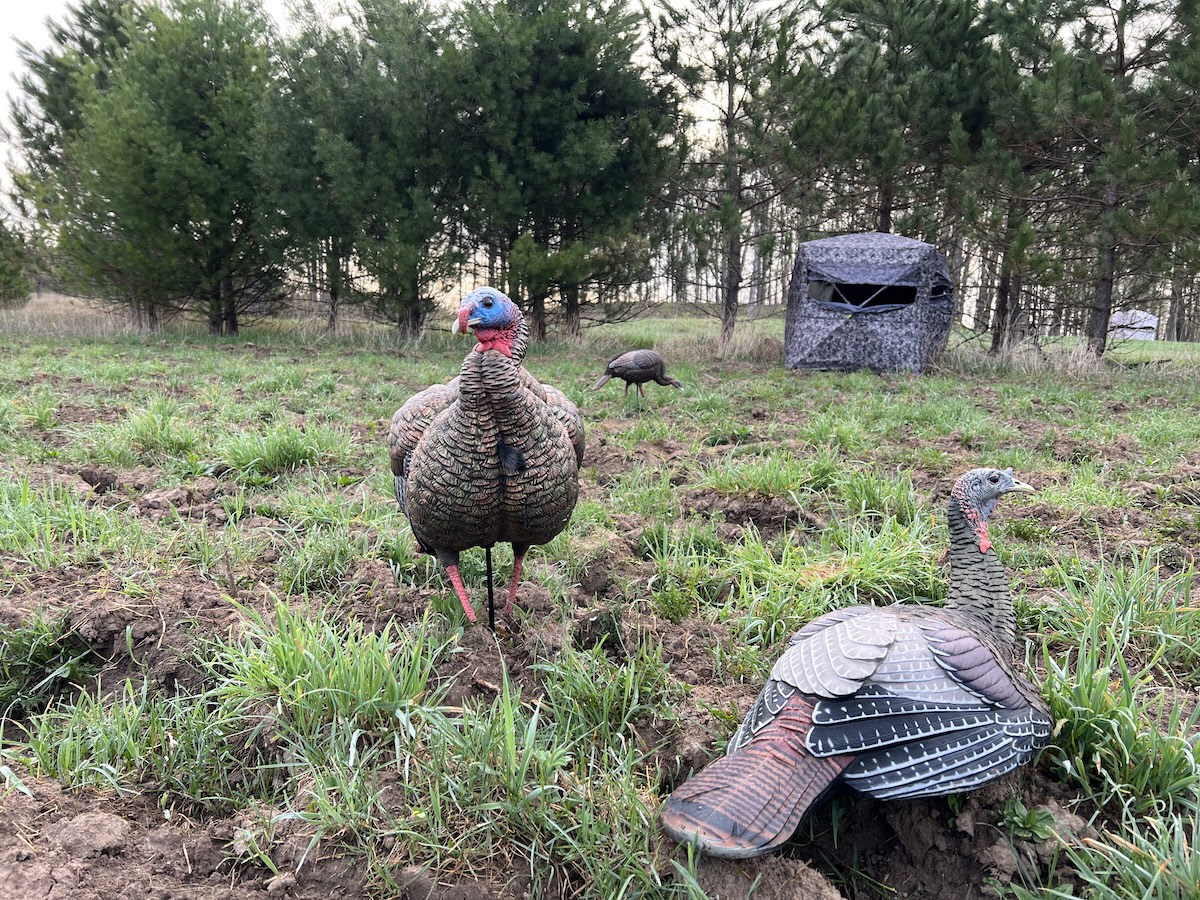
Use high-quality decoys to increase success.
Decoying Midwestern Turkeys
I use the same two or three decoys regardless if hunting the Wisconsin timber or the Nebraska prairies. I often pairs the Avian-X HDR Jake with the HDR Feeding Hen and/or the LCD Laydown Hen. The HDR Jake’s realism and posture spurs aggressive responses from even the most heavily hunted gobblers.
Likewise, Lenk suggests that hunters, especially new ones, keep decoying simple. “You don’t need a dozen decoys,” he explained. “I usually only use one, two, or none at all in denser areas with limited visibility.”
If my first two hunting attempts in a particular area reveal that the gobblers aren’t looking to fight — this was the case during a recent South Dakota river bottom hunt — I pull the HDR Jake and go with the aforementioned two hen decoys. Whether by curiosity or dominance, I routinely find that hens are more likely to approach a hen-only decoy spread and drag the toms in with them.
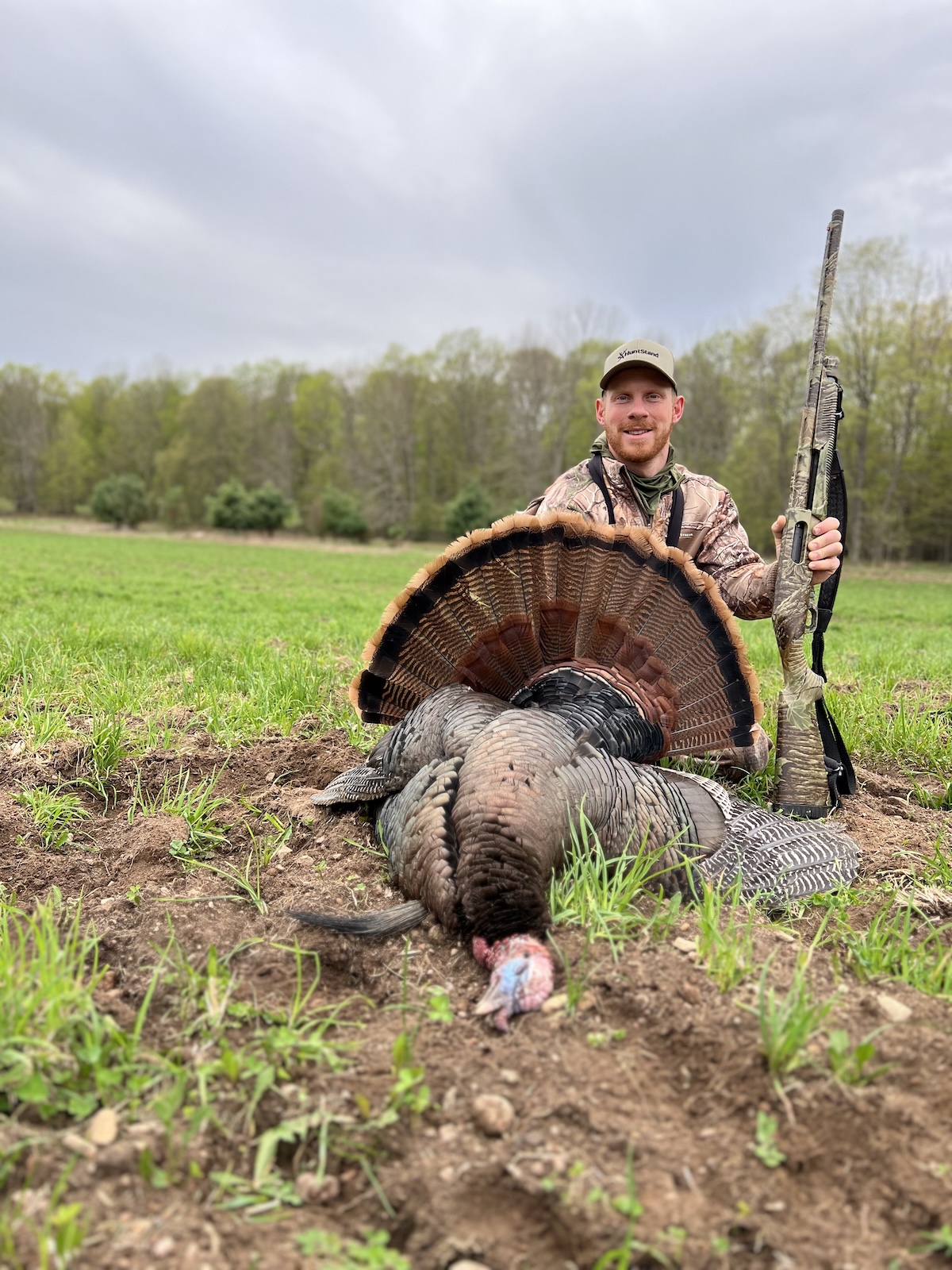
The author poses with a great Midwestern turkey.
Basic Tactics for Midwestern Turkeys
Fundamentally, anyone with camo, a shotgun, required tags/licenses/stamps, and a positive attitude can easily enjoy a good time hunting turkeys from Ohio to North Dakota. The most productive hunting approach on morning hunts is to set up within 150 yards of a roosted gobbler before daylight, then try to call and/or decoy him within range once he flies down.
If he goes the other way, keep hunting. You don’t necessarily have to stay in one spot until legal shooting time ends. Move around and use the terrain to stay on birds, with HuntStand Pro informing your moves. The best time of the day to kill a bird that was henned-up in the morning is midday.
Although it is somewhat controversial, an effective way to target late-afternoon toms (in states where it is legal) is to hunt near a roosting area. Avoid hunting too close to the roost trees, though, as exiting the area if the birds roost without giving you a shot opportunity is dicey.
Most shotgun hunting is done by suiting up in camo from head to toe and sitting up against a tree or some other object that disguises your outline. A ground blind such as Ameristep’s Banshee Wide Bottom Extreme provides solid concealment and the room to stretch your legs in between encounters without being detected.
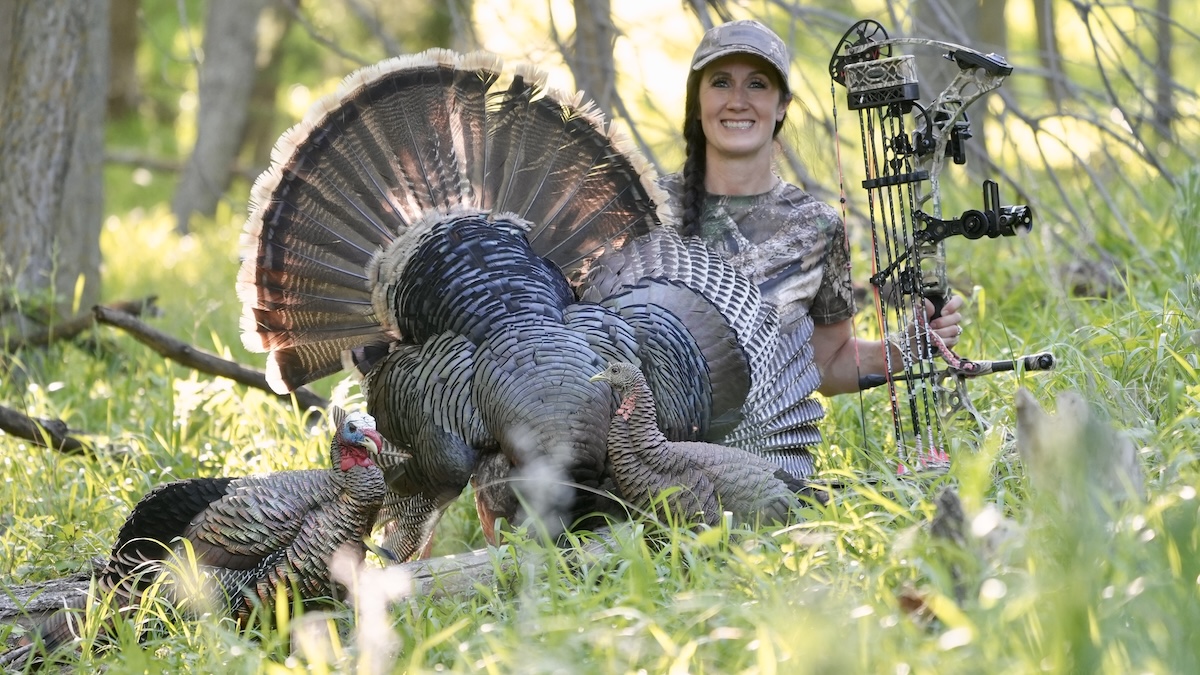
Melissa Bachman arrowed this fine bird.
Advanced Tactics for Midwestern Turkeys
While the basics discussed above will get you started, let’s dive deeper with HuntStand pro, Melissa Bachman. She says that hunting turkeys like whitetails has served her well.
“It’s funny to think about patterning turkeys like you would whitetails, but putting in the extra time up front helps you hunt the right areas,” she began. “Pre-hunt scouting and especially e-scouting with HuntStand is invaluable. I rely heavily on pre-hunt scouting. I know where the turkeys roost, I know where they go and what they do, and I’ve gotten them on my trail cameras. If I notice that birds aren’t sticking around on the property I hunt, I use one of the app’s satellite base maps to get a bird’s-eye view of the area and determine where they might be going. I’m also attentive to major habitat changes — fires, flooding, and timber cutting — that can affect turkey patterns. Monthly Satellite Imagery helps with that.”
When Bachman hunts in Illinois, where legal shooting hours end at 1 p.m., she likes to park on a food source that birds frequent throughout the morning. “I get out there really early in case birds are roosted over the field, and I usually set up on fields in ground blinds,” Bachman said. “Yes, I’ll call and use decoys, but I know they’re coming to the fields I hunt, regardless, based on my scouting efforts. These classic Midwestern birds in Illinois have pretty set patterns, so a stationary ambush on agriculture is my go-to strategy, especially if I’m bowhunting.”
In contrast, Bachman rarely starts her South Dakota and Nebraska turkey hunts before mid-morning, and she often covers some ground. “My family doesn’t do a lot of super-early morning hunts because we’re able to hunt all day in these states,” she explained. “You can wear yourself out by being out from dark to dark, day after day. Plus, I firmly believe that turkey hunting has to be fun.
“When hunting prairie birds, we like to get up on a high point and put a few calls out there to see if we can hear gobbling or see birds,” she continued. “If I hear or see a gobbler, we cut some distance before setting up to call. If there is minimal cover, we’ll hold a fan up to disguise our approach.”
Everybody wants to hunt early birds, but from Minnesota to South Dakota’s Black Hills, Lenk commented, “Hunting later in the season can be just as fruitful as the early season. Birds may be a little more ‘street smart’ from hunting pressure, but with most hens nesting or incubating by then (depending on the state), the remaining males get a little more desperate for attention and become susceptible.”
The Best Turkey Hunting Spots (and How HuntStand Pro Finds Them)

Hunt the Midwest for turkeys this season.
Turkey Hunting in the Midwest
As we close, we’ll leave you with some little info nuggets relative to the Midwest’s different states. In Wisconsin, some less-publicized public hunting opportunities occur on private lands enrolled in a timber-management program called Managed Forest Law (MFL). Not all enrolled parcels are open to public recreation, so be sure to reference the MFL map on the Wisconsin DNR website. MFL lands aren’t decorated with signs like state-owned parcels and therefore draw less hunting attention.
A reputable Minnesota resident once said that certain parts of the state, particularly away from population centers, can be busy during the first half of the season but nearly vacant of hunters toward the end. This, coupled with nesting or incubating hens, can make for some excellent calling responsiveness.
In Michigan, there are vast federal and state forests with abundant turkey habitat. Dig into your HuntStand app with the Public Lands overlay and identify the areas farthest from roads and trails to find birds that haven’t been pressured. You’ll have room to roam, so be prepared to hike and call for as many miles as it takes to strike up a receptive gobbler.
In the Dakotas and Nebraska, riparian areas attract the most hunter attention, so don’t overlook the prairies. It only takes a small roost-tree cluster to hold a group of Merriam’s or Hybrids, so long as food and water are nearby. It’s really easy to drive right by such hotspots.
In Ohio, Indiana, Illinois, and Iowa, especially regions where agriculture outweighs the timber, spend the hot midday hours in the limited timber when other hunters hang it up, especially along creeks or rivers. At some point during the day, if you put in the time, gobblers will seek shelter from heat and hunting pressure in the limited timber, and your hunt can go from zero to hero quickly.
In Kansas, focus your public land efforts on a state wildlife area with a reservoir, lake, or river, but be sure to scope out adjacent Walk-In Hunting Areas. All of these are visible in the HuntStand Pro app with the Hunting Lands overlay engaged. These smaller satellite properties are often overlooked, and you might find a small flock all to yourself, especially in central or western Kansas where there are fewer hunters.
Finally, the Missouri Department of Conservation’s Wild Turkey Harvest and Population Status Report notes that the Ozarks West and Lindley Breaks Regions have increasing turkey populations based on the recent five-year trend. Because some of Missouri’s other regions have seen declining numbers, you might want to focus on these two regions.
There are many nuances to hunting wild turkeys in the Midwest. This deep-dive article provides you with more than enough information to have a fun hunt. Now, all that’s left to do is embark on a turkey hunt in North America’s heartland, the good ol’ Midwest. There is no place like it.